
Trinity-Street, Rotherhithe, Surrey • November 26th, 1796, a Saturday, early evening
Stay a moment—; I must dim our Lanthorn. Now, come a little nearer to the Window, just close enough to see into the Parlour, but not so near as to alert the Occupants. They are Mr. & Mrs. Greensword, late of Brook-St., Holborn, married for 22-years.
Mistress Sarah appears to be dozing in the Chair before that small, but cheerful Fire (dare I say, Reader, somewhat in the manner of a cliché?). Her Chair is placed at an Angle to us, for which we should be Grateful, or we would not Notice her at all. Her face is unfortunately obscured by the Ruffle on her Mob-Cap.
Her Husband is seated at a small Table with his back to us. He appears to be in his shirtsleeves, his Work illuminated by inadequate light, whether of a Candle or inferior Lamp, I cannot tell. Ah, but did you notice his Quill flash into view just now, no doubt as he dipped it into his Ink Horn? Too gloomy? I agree this is disappointing, but at least the Curtains are not drawn. In any Case, I have much to tell you about your Relative.
Mr. Joseph Greensword, aged 47, is the Teacher of Navigation and Lunar Observations at the United Society’s School. At present, he is engrossed in Editing a Manuscript of his own Composition. What is more, I can tell you with complete Confidence that his Labours will bear Fruit. Indeed, a copy of his Pamphlet will eventually find its way into the British Museum, with MVSEVM/ BRITAN/NICVM stamped on its final page.
By this time next year, viz. 1797, Mr. Greensword will have published, at his own Expense, his Pamphlet entitled A Very Easy and Short Method of Finding the True Distance Between the Moon and the Sun, or a fixed Star, for the purpose of Determining the Longitude.[1]
If you are still in England at the time, you will be able to secure a Copy for 1-shilling from Mr. Steel, Bookseller, of Tower-Hill; the Mathematical Instrument Makers’ premises in Leadenhall-St.; Mr. Delahoy’s, should you happen to be in Deptford; or the Author at his School, which I heartily recommend. It would surely be a fine Memento of your visit here, although from what I understand, the Subject Matter is rather dry.
Are you of the Disposition that takes enjoyment in Logarithmic Computations? No—I suspected not. But perhaps you might approve the Reproduction of the Title-Page of the Pamphlet in the written Account of our Travels? I am more than happy to comply.
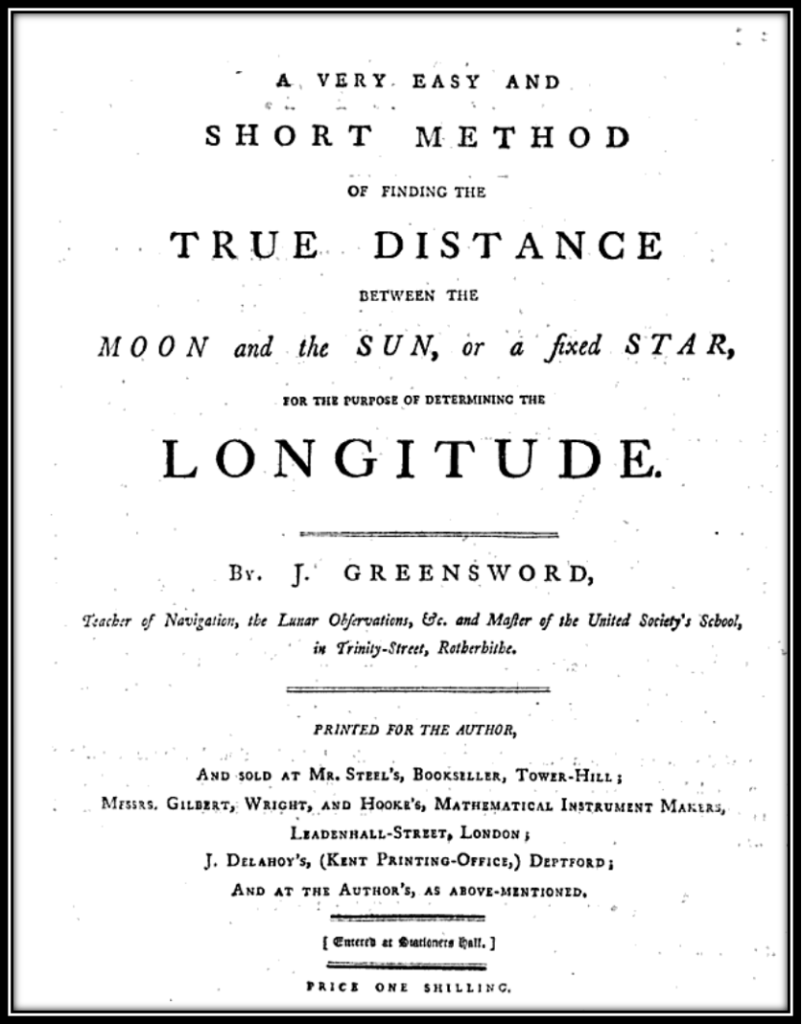
Figure 4. Title Page, A Very Easy and Short Method of Finding the True Distance Between the Moon and the Sun, or a fixed Star, for the purpose of Determining the Longitude. J. Greensword, printed for the Author
I do not know about you, Esteemed Patron, but I am most Curious to know what motivates our School-Master’s Endeavour, not to mention the Pounds, Shillings and Pence he shall expend to publish his Pamphlet. What do you think? No idea whatsoever? Then indulge me in my Speculations, if you will.
There have been, for much of this Century,[2] generous Prizes on offer to those who might discover an accurate Method of determining Longitude. One would have thought this task to have been persuasively accomplished by Mr. John Harrison and his Invention, the Marine Chronometer.
But a Chronometer being an expensive Object, the Lunar Method continues to be practised. Indeed, there is still Prize Money to be won for Improvements to the Lunar Tables of the German Astronomer, Herr Tobias Mayer, although at only half the Rate on offer before 1774.
Perhaps our School-Master fancies himself a Contender for the Prize? No man of his Station would look askance at a sum of £5,000 and upwards. Not when the average Wage of a School-Teacher will be just £43.11d. per-annum when Mr. Greensword’s Pamphlet is published next year.[3] In fact, I fear Mr. Greensword earns considerably less—if, that is, the Living of the School-Master of the United Society’s School set down in 1818 is any indication.
I have transcribed the relevant Matter for the Reader’s information:
The United Society Charity School, in which 41 boys are educated; the master receives £30 per annum, a house free of rent and taxes, and £3.1s. for coals. The Fund consists of £500 Navy 5-per-cent, accumulated during the past 30 years, with the over-plus of yearly subscriptions, £25; voluntary subscriptions, average from £65 to £70 per annum, … And the ground on which the school now stands, is held at a peppercorn rent under the Duke of Bedford.[4]
His Status and Remuneration might be greater were Mr. Greensword to tutor several boys of High Rank or young men with good Connexions or teach at the Naval Academy at Portsmouth, although from what I understand, the latter is hardly to be preferred.[5] Then again, as he is the School-Master of a Charitable School, perhaps his principal Motivation is not personal Gain.
History does not currently shew that Mr. Greensword wins any Prizes for his Method for the Calculation of Longitude. In fact, it has already been considered by the Board of Longitude, to which he submitted his Tables in 1793 or thereabouts.
His Submission is recorded in the Minutes of the Meeting held at the Admiralty on Saturday the 12th of December 1793, being read to the Board, the Commissioners of which were appointed by Acts of Parliament for the Discovery of Longitude at Sea, and consisted of: the Astronomer Royal; the Savilian Professors of Astronomy and of Mathematics at Oxford; the Lucasian Professor of Mathematics, the Plumian Professor of Astronomy, and the Lowndes Professor of Astronomy, all at Cambridge; the Secretary of the Admiralty; and the President of the Royal Society, Sir Joseph Banks.
Unfortunately, I know not the actual Content of Mr. Greensword’s Letter. However, the Minutes describe the general Claims it makes, along with the Board’s Resolution as to what was to be done with it (and the several Letters also read out that day). According to the Archives of the Board of Longitude, your Ancestor represents
… that he hath found out a peculiar method of Computation of the effect of Refraction and Parallax, on the Moon’s distance from the Sun or a Fixed Star for the purpose of ascertaining the Longitude. The process of which he presumes is not only much shorter than any method of Calculation yet offered, but is so very easy as to be reduced to the level of the Capacity of every common Mariner.
The Board resolved that these Letters with their several enclosures be referred to the Astronomer Royal, and that he be desired to report if they contain any thing worthy [of] the Board’s attention. [6]
Mr. Greensword’s Method is next referenced in the Minutes of the Meeting held on Saturday the 1st of March 1794.
In regard to the several Letters referred to him at the previous meeting of the Board, the Astronomer Royal, the Revd. Dr. Nevil Maskelyne D.D. F.R.S. F.R.S.E., declares that 3 of them require no further attention. As to the Submission of your Relative, the Minutes shew
That Mr. Greensword’s Method of computing the effect of Refraction and Parallax, or the Moon’s distance from the Sun or a fixed Star, for the purpose of ascertaining the Longitude, appears to him very ingenious but that not having had time fully to consider it, he deferred making his Report thereon, till the next meeting of the Board.[7]
Finally, the Astronomer Royal submits his Assessment.
This takes place at the Meeting of the 7th of June 1794, where he determines that Mr. Greensword’s
… method of clearing the Observations of the distance of the Moon [&c. &c.] was not so accurate as the one prefixed to Taylor’s Logarithms, And when the Logarithms of Table 9 of the requisite Tables is used, there is one Logarithm less to take out.[8]
Not being fully cognisant of the Connexion between Calculus, Astronomy, and Navigation, I cannot tell if Dr. Maskelyne’s Evaluation was just. Perhaps it was Recognition enough that your Relation’s Enterprise merited the Notice of the Learned Members of the Board of Longitude on more than one Occasion. Perhaps the Content of his Work in Progress makes advances on his Logarithms of several year’s past?
Gentle Companion, this seems a suitable moment for me to suspend my Narrative and depart Trinity-St. Let us leave Mr. Joseph Greensword to his Manuscript and his wife, Mrs. Sarah, to her slumber. It is getting late and certainly colder. What do you say?
Good Lord! Your Teeth are chattering! I did not hear them over the Sound of my own Voice. My most sincere apologies. Come, let us hasten to our Accommodations, where a roaring Fire surely awaits. While you thaw, I shall continue to entertain you with the Findings of the Genealogical Searches I have conducted on your behalf.
[1] The Pamphlet bears no date of Publication on its Title Page or within its pages. However, if one happens to secure an original Copy of Mr. Greensword’s miniature Opus, and holds a page up to the Light, one will perceive a Watermark, which is dated 1797. No doubt evidence of the Year of Publication will be noted in future bibliographical Information of those very select Libraries that hold a Copy.
[2] Since the Longitude Act of 1714.
[3] Mr. Jeffrey G. Williamson, “The Structure of Pay in Britain, 1710-1911”, Research in Economic History, volume 7, 1982, pp. 1-54.
[4] A Digest of Parochial Returns made to the Select Committee, Appointed to Inquire into the Education of the Poor, Session 1818, Volume 2, Ordered, by the House of Commons, to be printed, 1 April 1819, p. 224.
[5] The present instance to the contrary, maritime knowledge is regarded to be better learned at Sea than it is in a School-Room. The Naval Academy at Portsmouth, established in 1733, was, and is still, regarded with disdain by Naval Officers, being considered an affront to the system of Patronage upon which the Royal Navy has relied. Mr. James Anthony Gardener was there back in 1780. He describes the Master as a good man, but “who the devil taught him navigation is more than I can say”. See Recollections of James Anthony Gardner, Commander R. N. (1775-1814), Sir R. Vesey Hamilton, G.C.B., Admiral, and John Knox Laughton, M.A., D. Litt., Editors, Publications of the Navy Records Society, Volume XXXI, 1906, p. 15. The Master’s name was Orchard, not Greensword, you will be pleased to learn. You may be interested to know, however, that Francis William Austen (of an age with Mr. Joseph’s eldest son, Edward Nathaniel) was at the Academy. You are not familiar with Mr. Austen? My inquiry into his family leads me to believe he will very do well. His father is a Rector in Hampshire, and, incidentally, his younger sister, Jane, is an aspiring Novelist.
[6] Board of Longitude, “Minutes of a Meeting held on 7th of December 1793,” Confirmed Minutes of the Board of Longitude, 1780-1801, p. 349.
[7] Board of Longitude, “Minutes of a Meeting held on 1st of December 1794,” Confirmed Minutes of the Board of Longitude, 1780-1801 (RGO14/6), p. 358.
[8] Board of Longitude, “Minutes of a Meeting held on 7th of June 1794,” Confirmed Minutes of the Board of Longitude, 1780-1801 (RGO14/6), p. 364.
 A FAMILY TOPOGRAPHY
Dearest Narrator
Indeed, it is the case that I am without disposition to take enjoyment in logarithmic computations (haha!) but I must say I have enjoyed your informative company and to learn about Mr Greenswords endeavours. He seems an admirable hard worker with a charitable spirit; good thing the rent of the school meant he was only out of pocket a handful of peppercorns.
Warmest regards,
Your relative
LikeLike