
St. Mary Magdalene, Gillingham, Kent • 11th July, 1814, a Monday
This is the most ancient Church and Graveyard of the Parish of Gillingham. It is dedicated to St. Mary Magdalene, and is a Possession of the Archbishop of Canterbury. Arches separating the side Chapels from the Chancel, dating from the 12th century, have been incorporated into the present Church, with its distinctive Tower and Battlements. The Norman Font within is even older.
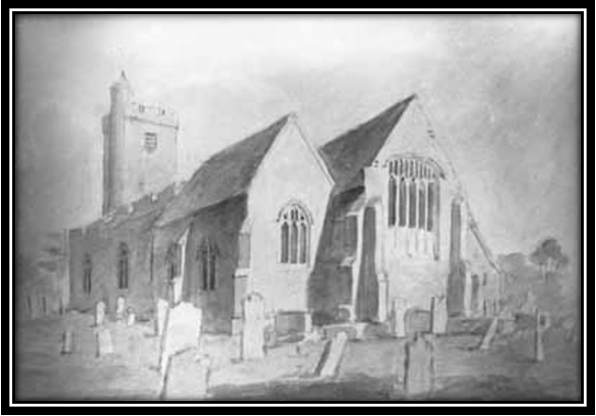
Figure 1. Parish Church of St. Mary Magdalene at Gillingham, c. 1807. Provenance unknown
Parishioners tell me that St. Mary’s has a long connexion with the Royal Navy and the Chatham Dockyards. They will attest to the fact that “For very many years our church tower was a navigational mark for ships sailing up the Medway Estuary. As such, the Church was required to fly a White Ensign by day and show a light on the tower by night”.[1]
However, you and I are not in Gillingham to witness Lieutenant & Commander Greensword and his family go about their naval and domestic businesses, respectively. They are all of them quite gone from here. All but one, which is why we have come to the Churchyard of St. Mary Magdalene’s today. We visit a grave. Look, here is the Stone.
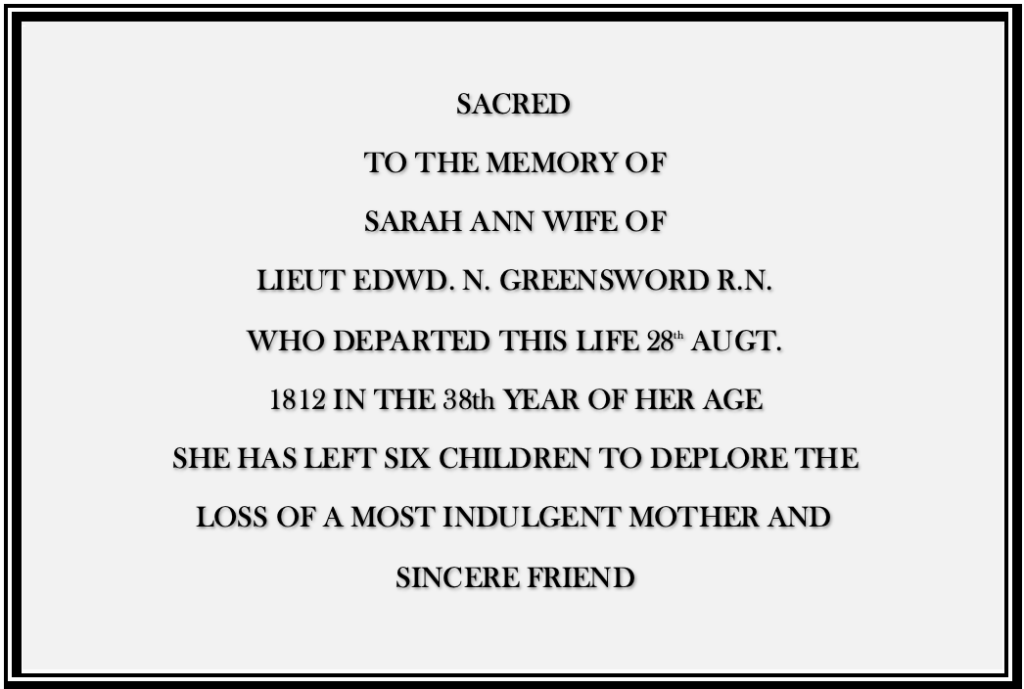
Figure 2: Headstone no. 533, “Monumental Inscriptions of St. Mary Magdalene Church, Gillingham. [2]
I have discovered nothing that will verify what Malady or Misfortune carried this Lady off, but I am inclined to believe it was a consequence of ongoing ill-health, very possibly caused or exacerbated by the trials of childbirth. Allow me to tell you what has transpired since our previous Family Topography Tour—upon the occasion of your Relative’s Courts-Martial and his Acquittal in mid-November, 1808—an event which no doubt remains etched in your memory.
May I say, I feared that in spite of Greensword’s honourable Acquittal, the loss of His Majesty’s ship, Tigress, might stand against him in his naval career and, and moreover, his capacity to provide for his family. It would be some months before your Relation acquired his next Commission. However, as luck would have it, the Prize money from H.M.S. Tigress’s capture of the Prussian bark, Fortuna, auctioned off in October 1806, was finally distributed on the 6th December 1808, providing a small financial boon to our Protagonist.
The specific whereabouts of Commander Greensword that December, indeed, the first six-months of 1809, is unknown, but he most certainly passed some of the Season of Epiphany with his wife and children in Yarmouth. This is evinced by the fact that a third son was born to Edward and Sarah Ann on the 16th of September 1809. Henry William was baptised on the 23rd of the month at the Church of St. Nicholas, Greater Yarmouth.[3] Whether the father was on-shore for the Christening is also unsure, given he had by then taken command of the gun-brig Manly.
On the 9th of June, 1809, H.M.S. Manly sailed from Chatham as part of a Convoy to the Baltic and White Seas. According to Muster Books supplied by a trusted Source in the Admiralty, the Commander’s elder two sons, Edward Duncan, aged 10, and Francis Joseph, who had just turned nine, went aboard as Boys, Third Class. For the duration of their absence, Sarah Ann took care of their surviving sisters, Louisa, aged six, and Eliza, aged four, and, from September, their infant brother, Henry.
Much joy must have accompanied the safe arrival of Henry William. After all, two years’ earlier his sister, Eleanor, had died within three weeks of her birth. Henry will grow to manhood, but perhaps little more than a year later than the time of which I speak, it became apparent that the Greensword family were facing further trying circumstances.
In early December, 1810, Lieutenant Commander Greensword sent a letter to the Admiralty requesting a change to his Commission. His request was granted. On the 17th of December, 1810, he took command of H.M.S. Fyen. She had been a Danish Prize, captured in 1807 at the Battle of Copenhagen, and was now stationed in Chatham, Kent.[4] His elder sons followed him aboard. Edward Duncan was now rated as a Volunteer, First Class. His younger brother, Francis Joseph, remained a Boy, Third Class.
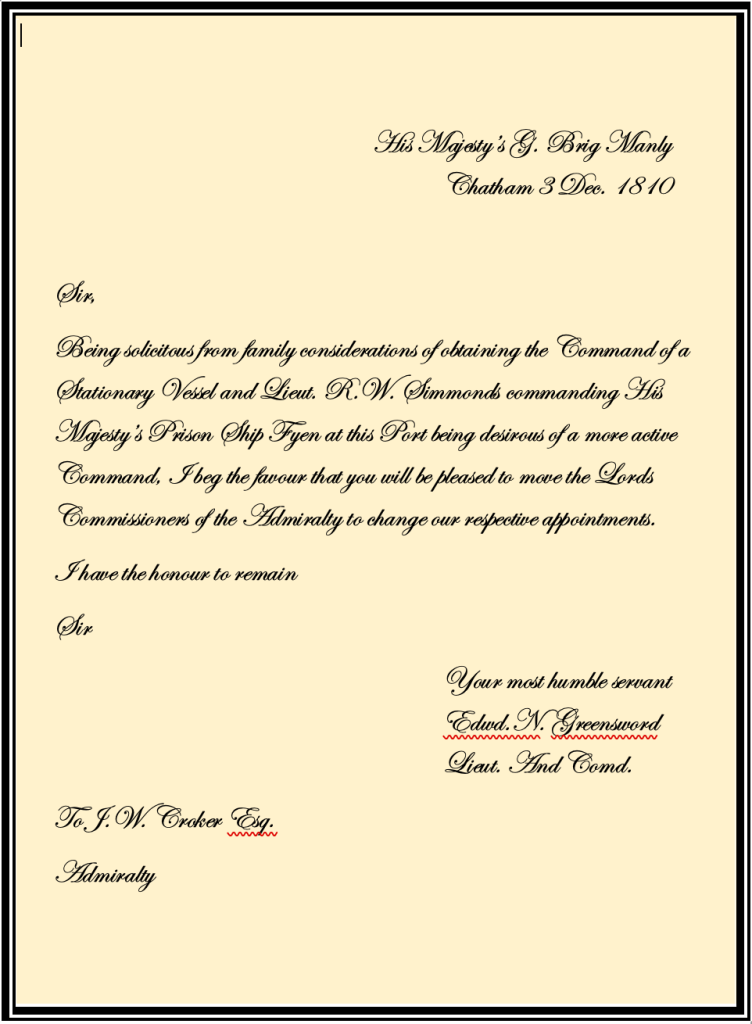
Figure: Facsimile of the Letter sent by Lieutenant and Commander Greensword to the Admiralty, 1810.
This turn-of-events must have been a bitter pill to swallow, being not to your kinsman’s advantage.
For, according to The Naval Chronicle of 1810, the Fyen lay in His Majesty’s Prison Ship Depot on the River Medway. [5] Her inmates were American and Danish Prisoners-of-War, although if Mr. Francis Abell is correct that the Fyen was at some point a Hospital-Ship, then these men were also Invalids.[6]
For the next several years, the Greensword family resided in Gillingham, which is located on the estuary of the Medway, and one-mile from Chatham. In fact, a large part of the Chatham Dockyard extends into Gillingham. As the sombre sight of Sarah Ann Greensword’s grave indicates, her husband’s consideration did not save her life.
The Gentleman and his family remained in Gillingham following the death of his wife. Based on reliable advice pertaining to the aforementioned Muster Book for H.M.S. Fyen, I can reveal that on the second day of April, 1813, Greensword promoted his son, Edward Duncan, to Midshipman and, on the 19th of May, changed Francis’s rating to Able-Seaman. Furthermore, Steel’s List of the Navy of Great Britain, published in July, 1813, states that the elder Greensword remained in command of the Fyen, Gillingham, at that time.[7]
On the 11th day of October, 1813, the younger Edward, aged 15, went to H.M.S. Salamander, whereupon Francis, aged 13, was promoted to Midshipman. As for Louisa, Eliza and young Henry, history does not tell their stories or, indeed, who cared for them following the loss of their mother.
Edward senior and Francis remained with H.M.S. Fyen until one month after the Peace Treaty of Paris. According to Mr. Chamberlain, the Prison Depots and Hulks have rapidly emptied of prisoners. Moreover, the Admiralty has already taken steps to dismantle those establishments that housed French, German, Italian, Danish and Dutch Prisoners of the Napoleonic Wars.[8] The Prison-Ship Fyen is to be sold and broken up.
As a consequence, it seems safe to assume that your Relative found himself without a Vessel in his charge. Less than a fortnight ago, on the 29th of June 1814, to be precise, Edward Nathaniel Greensword, Lieutenant & Commander, went ashore. He has not long turned 40 years of age, but I am given to believe this moment marks the end of his Naval Career.
§
Reader, the Tourist has departed, as is their wont. That person expressed neither the desire to accompany me on a Walking Tour of Gillingham nor observed the discrepancy between my account of the surviving five Greensword children in 1809 and the fact that there were six children that deplored their mother’s death 1812. Allow me to reveal the fruits of my many Labours to explain this contradiction, subsequent to our visit to the gloomy Graveyard of St. Mary Magdalene.
It took me quite some time to discover the identity of the sixth child. By then, I, too, had returned to London, although not before examining the record of births in the Greensword’s Parish, which is to say, the Christening records in the Churches of Gillingham and thereabouts. Perhaps the Rectors and Deacons I consulted were indifferent to my quest; perhaps there has been a misspelling of the parents’ surname.
Her name was Charlotte. She was Mr. & Mrs. Greensword’s seventh child, and their fourth daughter. Presently, I do know either the date of her birth or baptism. However, I have now discovered that she died just a few months after her mother. Charlotte was buried in the Churchyard of St. Mary Magdalene on the 13th of December, 1812.
I am inclined to believe that the infant was interred with her mother, but, as it is plain to see, the Stonemason was not called upon to make this apparent on the Headstone. It nonetheless remains the case, that two Greenswords remain in Gillingham to this day.
§
1 http//www.gillinghamparishchurch.org.uk/history-1/
2 “Monumental Inscriptions of St. Mary Magdalene Church, Gillingham, recorded in 1862 by Captain Connolly, Royal Engineers”, Kent Archaeological Society, https://www.kentarchaeology.org.uk/Research/Libr/MIs/GIL/06.htm. See, also, The Monthly Magazine or British Register, Volume 34, Part II for 1812. Printed for Mr. Richard Phillips, London, Mr. J. Adlard, printer, 23, Bartholomew-Close and 39, Duke-Street, Smithfield, p. 281.
3 Henry William, baptised at Yarmouth, Norfolk, in 1809, was baptised for a second time on the 1st of March 1813, aged three, several months after the death of his mother. His name, his parents’ names and date of birth recorded on both documents are consistent. I am unable to explain this practice. Was it because his father was not present at his first Christening?
4 “Naval Appointments”, Perth Courier, Monday 31 December 1810, No. 151, p. 3.
5 The Naval Chronicle: Containing a General and Biographical History of the Royal Navy of the United Kingdom with a Variety of Original Papers on Nautical Subjects, July–December 1810, Volume 24, James Stanier Clarke and John McArthur, editors, Cambridge, Cambridge University Press, 2010, p. 513.
6 <amr. francis="" abell,="" Prisoners of War in Britain, 1756–1815, A Record of their Lives, their Romance and their Sufferings, London, Oxford University Press, 1914, p. 51.
7 <aA Complete List of the American Navy: Showing the Name, Number of Guns, Commanders’ Names, and Station of Each Vessel, with the Names of All the Officers in Service, for October, 1813; and Steel’s List of the Navy of Great Britain, for July, 1813, Boston, Russell, Cutler, and Company and Joshua Belcher, 1813 p. 56.</a
8 Chamberlain, Paul, “The Release of Prisoners of War from Britain in 1813 and 1814”, Napoleonica. La Revue, Vol. 3, No. 21, 2014, pages 118 to 129.
 A FAMILY TOPOGRAPHY