
St. Paul’s Coffee-House, no. 5, St. Paul’s Church-Yd., London, Middlesex • January 30th, 1797, a Monday, almost midday
I am pleased to inform you our Coffee is already boiling. Oh, yes, indeed; a decent pot of Coffee needs spend 15-minutes or thereabouts on the boil. I am gratified by your Enthusiasm, but I am given to understand the Brew must rest for another 5-minutes in order to achieve the necessary Clarity. I requested a jug of thin Cream and some lump Sugar be brought with our Coffee.
I do believe there is enough time for me to preface the Genealogical Facts I have to hand about Mr. John Greensword’s family with a further Anecdote about his Coffee-House.
Like the Queen’s Arms Tavern next-door, not to mention Child’s Coffee-House (a mere stone’s throw away),[1] St. Paul’s hosted Clubs for Gentlemen. The most famous was the Club of Honest Whigs, which met here regularly during the 1760s and 1770s. They styled themselves as “Friends of Science and Liberty”. Notable Members of the Club were: Mr. Richard Price, a non-conformist Minister, Moral Philosopher & Mathematician; Dr. Joseph Priestley, a Natural Philosopher & Chemist, and Mr. Benjamin Franklin, an American, Political Philosopher, Inventor & Diplomat.
I cannot say if the Club formed before Mr. Greensword died, but it was certainly still extant by the time his son had become a young Man. Perhaps, like us, Joseph took himself here, both in remembrance of his Father and to satisfy his intellectual Curiosity. I rather suspect he, too, is a friend of Science and Liberty.
Therefore, permit me to indulge you in the Picture that Mr. Boswell, the Biographer of the eminent Lexicographer, Mr. Johnson, paints of a Meeting of the Club of Honest Whigs held at St. Paul’s Coffee-House on the 17th day of September 1769. He writes:
I went to a club to which I belong. It meets every other Thursday at St. Paul’s Coffee-house. It consists of clergymen, physicians, and several other professions. … We have wine and punch upon the table. Some of us smoke a pipe, conversation goes on pretty formally, sometimes sensibly and sometimes furiously. At nine there is a sideboard with Welsh rabbits and apple-puffs, porter and beer. Our reckoning is about, 18d. a head.[2]
I fear the reckoning for the same Refection will be somewhat more than the 18d. today, but if the Cook can cater to a Whim, shall we partake of Welsh Rabbits followed by Apple Puffs? Very good. I will speak to the Master.
§
Friend, I am delighted to inform you the Master has agreed to have his Cook accommodate our culinary Caprice! He also gave me something to give you. A small Keepsake, as it were.
I was sorting through my Purse to find the correct Coin when I thought to ask the present Custodian if he knew any interesting Facts or Anecdotes about St. Paul’s Coffee-House that might be of interest to Visitors. I regret to say, he knew nothing of the years when your Ancestor was its Master, but do not be disappointed! He gave me the House Card with my Change. It shews Mr. Greensword’s Coffee-House has updated its name![3]

Figure 18. Draft Trade Card for Coffee House, St. Paul’s Churchyard, London, The British Museum, date unknown
Ah, here are our Welsh Rabbits! Let’s eat them while they are hot!
§
It is time to tell you what I know of John Greensword’s wife, Margaret, and their young son.[4]
The Widow Greensword married the Widower, Mr. James Williamson, Gentleman, in the Parish of St. Gregorye by St. Paul, on the 28th of April 1756, a scant 4-months after her husband’s Burial—; evidently with the Rev. Wm. Reyner’s blessing. No doubt the couple were already acquainted; but how I have yet to ascertain. In any case, Margaret swiftly found Joseph a new Father, at least one new step-brother and, by the end of the following year, a half-sister.
Jane Maria Ann Williamson was baptised on 26th of December 1757 at St. Gregorye by St. Paul. The Register identifies her father, Mr. Williamson, as a Coffee-Man of St. Paul’s. By the following year, the Coffee-House is in the hands of a Mr. Rowley. I suspect that the Family remained in the Vicinity, but because the Tax Records shew more than one Gentleman of the name of James Williamson in the same and nearby Precincts, I cannot be sure where.
I have no Knowledge of Joseph Greensword until early 1765, when I find a likely, albeit unproven, Trace of the boy, who would be by then 14-years-old. On the 16th day of February a young fellow named Joseph Greenswood was apprenticed to Mr. Armishell Winchley, of Angel-Ct., Westminster, an Attorney. Was his Surname misspelled? It would not be the first time!
You may well think this wishful Thinking on my Part, since your Joseph became a School-Master, not an Attorney; but that might be because it is only now that I am able to tell you that Mr. Winchley kept an Academy in Angel-Ct.!
According to an “advertizment” published in the Daily Advertiser of the 5th day of January 1770—by which time Joseph would have been 19-years of age—Mr. Winchley’s Academy undertakes to Instruct young Gentlemen “in those useful branches of Literature, necessary to complete the Scholar, or fit the man of business”. Pedagogy is based on the “latest improvements”, and “every Pupil is advanced progressively” according to their Skills and Dispositions.[5] A most broad-minded approach. What do you say?
I am glad you approve of Mr. Winchley’s Pedagogy. As to your further Comments & Observations, I see why you think the Literary Curriculum of his Academy inconsistent with the Mathematical & Astronomical Learning for which Mr. Greensword is known to us. But, should you believe those “useful branches of Literature, necessary to complete the Scholar” irrelevant to a future Teacher of Navigation, you would be Mistaken. Your own Relative proves my Point!
When Mr. & Mrs. Greensword lived in Brook-St., Holborn, the School-Master composed a Poetic Tribute to his Friend, Monsieur Jacques Samuel Charrier, the Author of A New Description of Europe (1781)Your Relative’s Ode is amongst a variety of Prefatory Material to that Title. With your Permission, I will reproduce the Poem in the published Account of our Travels.
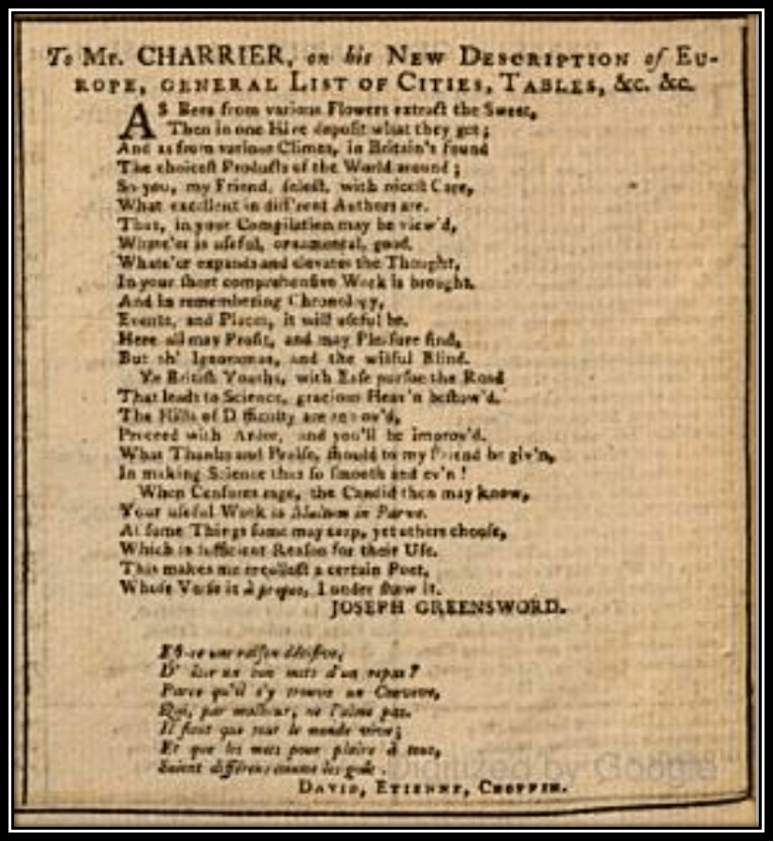
Figure 19. Mr. Joseph Greensword, in M. J. S. Charrier, A New Description of Europe, &c. &c. 1781
Meanwhile, since the Apple Puffs have arrived, let me read it to you while you eat them.
To Mr. Charrier, on his NEW DESCRIPTION of EUROPE, GENERAL LIST OF CITIES, TABLES, &c., &c.
As Bees from various Flowers extract the Sweet,
Then in one Hive deposit what they get;
And as from various Climes, in Britain found,
The choicest products of the World around;
So you, my Friend, select, with nicest Care,
What excellent in diff’rent Authors are.
Thus, in your Compilation may be view’d,
Whate’er is useful, ornamental, good.
Whate’er expands and elevates the Thought,
In your short comprehensive work is Brought.
And in remembering Chronology,
Events, and Places, it will useful be.
Here all may Profit, and may Pleasure find,
But th’Ignoramus, and the wilful Blind.Ye British Youths, with Ease pursue the Road
That leads to Science, gracious Heav’n above bestow’d.
The Hills of Difficulty are remov’d,
Proceed with Ardor, and you’ll be Improv’d.
What Thanks and Praise, what to my Friend be giv’n,
In making Science thus so smooth and ev’n!When Censures rage, the Candid then may know,
Your useful Work is Multum in Parvo.
At some Things some may carp, yet others choose,
Which is sufficient Reason for their Use.
This makes me recollect a certain Poet,
Whose Verse is à propos, I under shew it.[6]
[Reader, it was to my immense Embarrassment that I could not to speak the Verse in question to my Client, this being due to the Quality of the Copy I had at Hand. You, no doubt, will have easily deciphered the concluding Verse in the Reproduction above. Fortunately, my Companion did not realise my Recitation was incomplete, making no Inquiry as to the Identity of the “certain Poet” to whom the Poet refers; viz. the renowned French Philologist, M. Davide Étienne Choffin.]
My constant Companion! I know you are curious about the putative Friendship between Mr. Greensword and M. Charrier asserted in the poetical Composition of the Former. Was it merely a convenient Trope or an actual Matter of Fact? I fear I cannot yet satisfy your Curiosity.
Very well. Since you insist, I shall present several Circumstances and Coincidences that suggest a Connexion between the two learned Men.
As the front Matter of A New Description of Europe tells us, M. Charrier was a Teacher of Geography, the Use of the Globes, the French Language, &c., in London when he composed his ingenious and concise Publication. I do not know where he was teaching in 1781, let along Mr. Greensword; but, in my humble opinion, a Master of the Globe & Geography, and a Master of Navigation & Mathematics, are not such very strange Bed-Fellows. Were they Colleagues?
The next intriguing Coincidence concerns Monsieur J. S. Charrier’s religious Persuasion. A sometime Merchant Sailor and twice captive of the British Channel Fleet, he and his Wife arrived in England in 1764 as religious Refugees. In London, they attended the English Church. Madame Charrier died in 1767.
Apparently M. Charrier was particularly enamoured of the Rev. Mr. William Romaine, who was Rector of St. Andrew by the Wardrobe from 1766 to his Death. Rev. Romaine was to undergo an evangelical Conversion. At one point in time, he was a Chaplain for the Countess of Huntingdon’s Connexion. Ah, I see by the Look on your Face you recognise the Significance of that name. Yes, her Chapel stood on Spa Fields, near the Burying-Ground where Mr. & Mrs. Greensword interred their late children. Did Faith bring Greensword and Charrier together? Or was it, in fact, a family Connexion?
In the process of time— viz. 1768, a year after his Wife’s decease—M. Charrier remarried. His young Bride was the daughter of an Attorney, Miss Hopkins. Need I remind you, Mr. Joseph Greensword’s daughter-in-law was a Hopkins?
I have read the Marriage Bonds & Allegations, which identify Charrier’s Bride as, Elizabeth Hopkins. She was born in 1748. Her Mother, Mrs. Sarah Hopkins, signed the Papers, suggesting the unnamed Attorney was dead. His Christian name is not given.
Truth be told, I am yet to establish a Connexion between the two former Miss Hopkins. Perhaps our next Tour will reveal the nature of the Association between the Greensword, Charrier and Hopkins families, if any. How so, you ask?
Shortly after the Publication of A New Description of Europe, M. & Mme. Charrier & their offspring decamped from London for Portsea, Hants. M. Charrier had taken up the Position of French Master to the Royal Naval Academy.[7] Portsea, mon Ami, is practically a Suburb of Portsmouth, whereto we will travel next in order to see Mr. & Mrs. E. N. Greensword![8]
§
Reader, I never did describe the Method of Research whereby I came to establish that Mr. John Greensword, Master of St. Paul’s Coffee-House, was the Tourist’s Forebear. It occurs to me that to do so may try even your Patience. I have decided, not without Reluctance, to consign my Research & Reasoning to a Footnote.
[1] According to Mr. Timbs, F.S.A, Child’s Coffee-House was frequented by Clerical types, Fellows of the Royal Society and, in its early days, Mr. Joseph Addison and Sir Richard Steele, who founded The Spectator. Reader, for further Information, please consult Mr. John Timb’s Club Life of London, with Anecdotes of the Clubs, Coffee-Houses and Taverns of the Metropolis during the 17th, 18th, and 19th Centuries. Volume. II, which was published in London in 1866 by Mr. Richard Bentley, New Burlington-St., pp. 91‑92.
[2] Mr. James Boswell, Boswell in Search of a Wife, 1766-1769, Messrs. Frank Brady & Frederick A. Pottle, Editors, New York, McGraw-Hill, 1956, p. 300.
[3] Mrs. Lois M. Fisher, A Literary Gazetteer of England, London, McGraw-Hill, 1980, p. 438.
[4] Joseph’s younger brother, Nathanael, died in 1752. I have no recent News of their step-brothers—Richard and William—though they are little older than the sons of their father’s second Marriage.
[5] Reader, I know a far more authoritative— and earlier Source—than what follows. I eschewed it in order to assist you to gain a sense of Proportion in regard to my Errors of Spelling and Style: Lord Elphinstone, Fifty Years’ Correspondence, Inglish, French, and Lattin, in Proze and Verse; Between Geniusses Ov Boath Sexes, and James Elphinston: In Eight Pocket-vollumes, Including an Appendix Miscellaneous. Dhe Oridginal Letters, To be Seen in Dhe Hands Ov Dhe Edditor. Volume III, London, Sold by Messrs. W. Ritchardson, Royal Exchange; T. Boosey, no. 4, Broad-St.; J. Deighton, no. 325, Holboarn; W. Clark, no. 38, Bond-St.; N.R. Cheyn; and P. Hil, Eddinburrough, 1794, price 1 Pound 8 shillings, pp. 209‑210.
[6] Mr. Joseph Greensword, “To Mr. Charrier, &c. &c.”, in A New Deſcription of Europe, in various Columns, whereby is exhibited in one View, all its Empires, Kingdoms, Republics, and States, &c. [in an Enumeration too long to copy]; The whole, being Multum in Parvo, is compoſed, calculated, and compiled, from the beſt Authors, by M. J. S. Charrier, Teacher of Geography, the Uſe of the Globes , the French Language, &c. Author of the Chorographical Deſcription of England and Wales, the geographical Tables of noted Cities, Improver and Editor of Dr. Nugent’s Pocket Dictionary, French and Engliſh, &c . Printed for the Author by Mr. J. W. Pasham, Black-Friar; and Sold by the Author only, who may always be heard of, at Mr. Dilly’s, No. 22, Poultry, 1781.
[7] Memoirs and Remains of The Rev. John Griffin of Portsea by his Sons, Messrs. Hamilton, Adams & co., Paternoster-Row, London; Mr. Samuel Griffin, Portsea, 1840, pp. 215‑219. Once in Portsmouth, M. Charrier became acquainted the Rev. Griffin. His Persecution in France inspired Mr. Griffin to publish a sermon, entitled “The Evils of Persecution, and the Advantages of the British Constitution”. The Rev. Mr. Griffin’s sons deemed the French School-Master’s Biography of sufficient Import as to devote to it a Footnote extending over several pages.
[8] A Coffee-House is a very different Milieu to a Workshop where Tin-Plate is beaten and soldered. I nevertheless felt compelled to Investigate the Identity of the late Coffee-House Master, even though our School-Master’s Admission to Freedom of the City papers explicitly states his father, Mr. John Greensword, is a Citizen and Tin-Plate Worker. I hereby describe the process of strenuous Thinking on the Subject and its Result:
1st—, I inspected the Record of Burials of Parishes in the Vicinity of St. Paul’s during the Time span of the aforementioned Issue of The Whitehall Evening Post, Or London Intelligencer. I now have proof that it was a Mr. John Greensword, of St. Paul’s Church-Yard, who was buried in a Grave in the Bunhill Fields on the 11th of January 1756. This is the very Burying Ground where the aforementioned Mr. Defoe is also interred.
2nd—, I investigated the Land Taxes for St. Paul Coffee-House paid in the Calendar year of his Death. My Search revealed that Taxes continued to be paid in the name of Williamson, the Surname of his Widow’s second Husband.
3rd—, I re-read Papers pertaining to the Infant Jos. Greensword’s Admission to Freedom of the City. I discovered a hitherto unnoticed hand-written Notation stating his Father’s place of Residence as St. Paul’s Church-Yard.
In sum, I believe the above Evidences support Claims made in this Chapter of A Family Topography.
 A FAMILY TOPOGRAPHY