
The Angel Inn, Great Yarmouth • 12th November 1808, a Saturday, at breakfast
The previous Monday
Dear ——.,
I am pleased to bring you news of your Relation, Lieutenant E.N. Greensword. Please find enclosed a Transcript of his latest Correspondence with the Admiralty.
I can confirm that your Relative’s request therein for a prompt Investigation into his Conduct has been granted this day, the 7th of November, and will be in Yarmouth in one week’s time, viz. Monday the 14th instant.
I strongly recommend we travel to Yarmouth at your earliest convenience so as to be present when the outcome of the Investigation is announced. With your permission, I will make arrangements for our Transports and Accommodations.
Your most humble and obedient servant &c., &c.
——.

Enclosure 1: Transcript of Letter from Lieutenant E.N. Greensword to Hon. W.W. Pole, Admiralty, London, 6th of November 1808, ADM 1/2899, provided courtesy of Messrs. G.J.F. S.— & F.J.G. S—. Needless to say, further identifying information about my Associates at the Admiralty cannot be disclosed.
§
Reader, with my Client’s approval I immediately booked the Accommodation Post-Coach from London to Yarmouth, via Bury, for the following Thursday. We left from the Spread-Eagle Inn in Gracechurch-St. and arrived yesterday at the King’s Head, from whence we proceeded to the Angel Inn. Both are in Market-Place, but the latter is said to be quieter and more highly-regarded than the coaching-inn.
What is that? Ah, yes. An astute observation, Reader, which indicates to me your comprehension is sound. We do have two full-days to pass before Monday’s “Investigation”. It is also true, as you point out, that my Companion was severely indisposed by our previous long coach journey, which was to Portsmouth. Therefore, your assumption that the Tourist will require two-days to recover in the present instance—resulting in nothing of interest to report until Monday—is reasonable.[1]
In this regard, may I say, the professional Family Topographer can do nought but accept situations such as you describe with Equanimity. At all times one must remain sensitive to the nuances—dare I say, Idiosyncrasies—of the Tourist’s disposition, predilections and general stamina, so as to be prepared to cancel or postpone Engagements, alter Itineraries, forfeit fares, fees, &c., &c.;—in other words, wait until the other is able to proceed with their Tour.
However, I have every reason to believe my present Client will be sufficiently recovered from their Journey to indulge in a day or two of Walking-Tours of sites of genealogical interest to Descendants of the Greensword family.
My confidence is based on the fact that my fellow Traveller slept practically the whole way, sleeping through both Turnpikes and numerous changes of horses. From time to time, that Person roused sufficiently to get off the coach when we were stopped for some Refreshment or other and to relieve themself, but did not speak to me.
Reader, I rather suspect a Sleeping-Draught was involved, for there were sections of Road so bumpy as to cause the coach to vibrate fit to wake the dead. Or, in the case of the ancient Gentleman sitting opposite me, to loosen the dentures in his mouth!
The Client’s deep slumber was of no account to me. I had with me several recent Volumes with which to amuse myself—and avoid the Spectacle of the ivory choppers across from me—the former consisting of the first of Mr. Wordsworth’s Poems in Two Volumes, published last year;[2] Mr. Scott’s romance, Marmion: A Tale of Flodden Field;[3] a pirated copy of Mr. Blake’s Milton with Plates;[4] and the current edition of Mr. R. Beatniffe’s The Norfolk Tour: or, Traveller’s Pocket Companion,[5] purchased specially for this Tour.
Needless to say, my reading much relieved me of the tedium of the road, although it is possible I, too, dozed from time to time.
The one regrettable outcome of the soporific effects of the journey is that the Tourist remains in ignorance of the particulars of their Forefather’s return to England, the military context in which H.M.S. Tigress was lost, and, perhaps most importantly, the precise nature of the euphemistic “Investigation”, of which we are here to learn the outcome. Reader, it is a Court-Martial.
Allow me to elaborate first on the Relative’s late return to England.
It is a matter of public knowledge that His Majesty’s Sloop, Calypso, landed here in Yarmouth on the 3rd day of November, three-days before Lieut. Greensword wrote his letter to the Honourable Mr. W.W. Pole at the Admiralty. I happen to know the Sloop arrived in the company of H.M.S. Goliath—and one day after H.M.S. Havoc, which had also come from Gottenburgh, leaving that place on the 28th ult., viz. last month.[6]
As indicated in his letter, Mr. Greensword did not return on his own. His companions—named in the margin of the original of his Letter—were: Mr. Tho. Spence, Second Master and Pilot; Mr. Chas. Bunting, Ass. Surgeon; Mr. J.A. Dublack, Pilot; Mr. Jas. Knight, Private Marine; and Mast. E.D. Greensword, Boy.
Reader, you are quite correct. The Boy is Lt. Greensword’s elder son, Edward Duncan. He is young, I agree. In fact, he was only 9-years-old when he was taken and turned 10 while in captivity, his birthday being the 6th of September.
I cannot tell you the whereabouts of the rest of the Officers and crew of H.M.S. Tigress.
As we know from her Commander’s previous letter of the 8th of August, there were 47 men on-board the Brig at the commencement of its engagement with the Danes. Two men were killed and one severely injured. It seems likely to me the remaining Survivors returned to England on Goliath or Havoc, if not by their own devices, then prest into service.
I am more confident that those that suffered Contusions of various degrees during the Action resulting in the loss of the Tigress are now much recovered.
As for the Court Martial on Monday, you will agree it is a very serious matter, indeed. Nevertheless, one should not necessarily infer from the fact of a Court Martial that Misconduct has invariably occurred.
Several learned friends at my Club told me during a combative game of Whist that a Court Martial is customary when one of His Majesty’s vessels is lost, which apparently means taken by an Enemy, not misplaced. The Company also advised me to consult and quote a published authority on the matter.
Thus, I got in touch with Mr. Delaphons, a Purser and occasional Judge Advocate in the Courts Martial, who did 3-years-ago update his Opus on the subject, A Treatise on Naval Courts Martial.[7] According to our Expert, when one of His Majesty’s Ships is
wrecked, lost or destroyed [then] a court martial shall be held, pursuant to the custom of the navy in such cases, to inquire into the loss of the said ship or ships, &c. &c.[8]
Let it be known that H.M.S. Tigress is far from being the only British ship recently lost to the Danes.
As you are well aware, Reader, Britain and Denmark have been at war since 1807, which is when the Second Battle of Copenhagen resulted in the destruction of much of the Danish-Norwegian Fleet. Now the British pick off Danish Privateers and Merchant Vessels, perhaps Lieutenant Greensword among them;—if Jetzomine den Rifken, which he took in December last year, is a Danish vessel.
Meanwhile, the clever Danes have strategized their Retaliation against the English. Their strategy presently depends on the humble Gun-Boat, which can be quickly and cheaply produced, and, while easily destroyed, makes a small target and is highly manœuvrable, in still and shallow waters especially.
To my knowledge, four English ship were taken by Danish Gun-Boats in the first two months of this summer:: H.M.S. Tickler on the 4th of June; H.M.S. Turbulent on the 9th inst.; H.M.S. Seagull on the 19th inst. H.M.S. Tigress on the 2nd of August. All are casualties of the so-called Gun-Boat War or, from the point of view of the Danes, the English War.
§
Hello! A very good morning to you, too! I must say, you look well rested! Am I right to assume your room was quiet and your bed comfortable? Marvellous!
My friend, I have already broken my fast, but I will keep you company while you eat your breakfast. It occurs to me that this will provide me an opportunity to brief you properly on Lt. Greensword’s late return to England, the significance of Monday’s so-called “Investigation”, and the military context surrounding the loss of H.M.S. Tigress.
Hmmm? You feel up to a walk this morning? Excellent! I am sure there will be ample time later on for me to bring you up-to-date on your Relation!
Furthermore, I have already given some careful thought to a variety of Walking-Tours in and about Yarmouth that will undoubtedly interest you, being based on my study of the Chapter on Yarmouth in the most recent edition of Mr. Beatniffe’s Traveller’s Pocket Companion to Norfolk published last January.
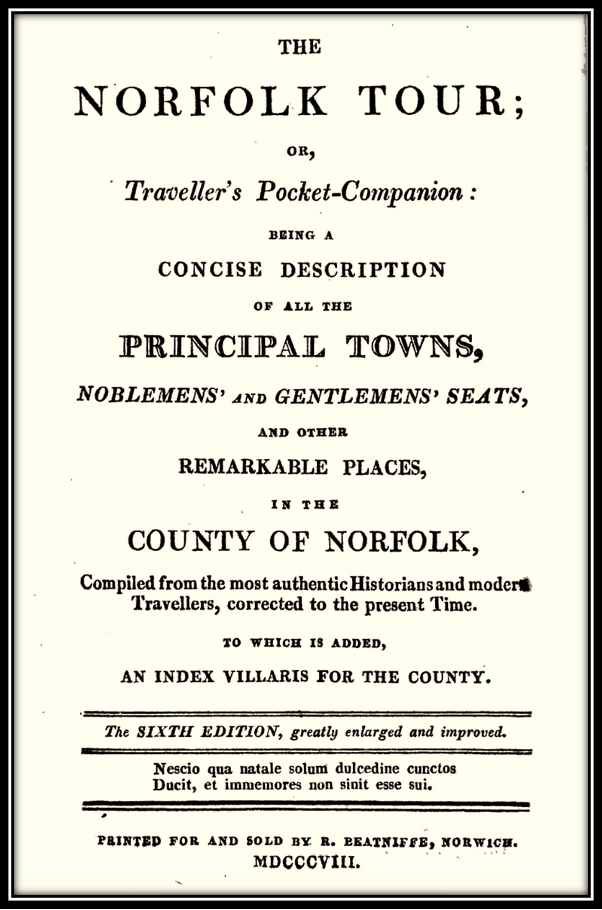
Figure 8: The Norfolk Tour: or, Traveller’s Pocket Companion, sixth edition. Printed and Sold by Mr. R. Beatniffe, in Cockey-Lane, Norwich, 1808.
I regret to tell you, Mr. Beatniffe says we are simply too late for this year’s Mackerel Fishery. There may be still time for the Herring if fish are of interest to you? Unfortunately, we will not have time to visit the antient ruins of the Roman Garianonum at Burgh Castle or botanize on the Denes. Naturally, we would take a Promenade on the new Jetty, were it not for the fact that it is not expected to be completed until the end of the year.
Thankfully, however, we have time and opportunity to explore the immediate environs of our Lodgings and thereabouts, viz. the Market Place, the Church of St. Nicholas, the town Walls and, most importantly, the Quay, which “is allowed to be the longest and handsomest in Europe”, and it is always alive with Officers, Seamen and Fishers, as well as curious Visitors such as we![9] I—:
Oh, yes … but of course. Goodness me. I am embarrassed to admit I have made no provision for the contingency of a “self-guided tour”, as you call it. Please forgive the oversight. Ahem.
Then you must have my copy of Mr. Beatniffe’s Traveller’s Pocket Companion. Luckily, Yarmouth has only four main streets and it is not difficult to orient oneself to the sea. Be aware, however, that there are 156 Rows or narrow Lanes between the through roads.[10] Take this Plan of Great Yarmouth for good measure. I obtained it from Mr. Faden’s shop while we were still in London.

Figure 9: “Inset Plan of Great Yarmouth”, A Topographical Map of the County of Norfolk, Surveyed and Measured in the years 1790, 91, 92, 93 and 94, by Mr. Thos. Donald, Mr. Thos. Milne & Assistants, Norfolk, England, Published by Mr. William Faden, London, 1797.
§
Reader, I decided to take a short stroll to take the sea air. I headed for the Jetty. Even though it is unfinished, its position seems to provide a good vantage point from which to view the Yarmouth Roads.[11] While there, I struck up a conversation with a man standing nearby smoking his pipe. He introduced himself as John Preston and revealed he is the Comptroller of His Majesty’s Customs in Yarmouth.
We chattered idly for a little while, before coming to the naval significance of the Yarmouth Roads. It seemed to me that my new friend waxed lyrical when he said
his Majesty’s fleets, lying in the roads, were victualled and watered from hence, and at the heads of which were the late gallant Admirals Duncan, Nelson, Onslow, Russel, Douglass, Mitchell, &c. who at that time displayed their proud flags in these roads, and who not unfrequently, with many other brave officers and seamen then fighting in their country’s cause, honoured Yarmouth jetty with their presence.[12]
I could but agree. Thus it was I told the man how the Client’s Relative came here with H.M.S. Triumph before she went to join the Battle of Camperdown with Duncan, Onslow, et al. I then explained why I was now in town and a little about my Theory of Family Topography. He was quite struck by the notion.
Mr. Preston revealed that he has produced quite a collection of Drawings of the Public Buildings hereabouts and received encouragement to furnish topographical and historical contexts for his Sketches such as to make them suitable for publication. However, he is not yet very advanced in this aspect of his Enterprise and I fear it may be some time before his Endeavours come to fruition.
This may be why he was so keen for me to reproduce one of his sketches in the Tourist’s Family Topography. I thanked him and asked him to forward his Drawing of the Yarmouth Roads with the forthcoming Jetty in the foreground to my office when convenient.
[1] Yarmouth being nearly twice as far from London as Portsmouth, it would appear to be entirely reasonable to assume the Tourist will require a day or two to recover. That said, the journey from London to Portsmouth in 1798 took longer than the present due to a series of unfortunate events. For details of the specific trials and tribulations, please see Book I, Chapter 9, of A Family Topography.
[2] Mr. William Wordsworth, Poems in Two Volumes, Vol. I. Printed for Messrs. Longman, Hurst, Rees & Orme, Paternoster-Row, London, 1807.
[3] Mr. Walter Scott, Esq., Marmion: A Tale of Flodden Field. Published by Mr. J. Ballantyne & Co. for Mr. Archibald Constable & Co., Edinburgh, 1808.
[4] Mr. William Blake, Milton, A Poem in Two Books with complete Illustrations. Printed by Messrs. [withheld] & [withheld], St. Paul’s Churchyard, London, 1808.
[5] Mr. Richard Beatniffe, The Norfolk Tour; or, Traveller’s Pocket Companion, Being a Concise Description of all the Principal Towns, Noblemens’ and Gentlemens’ Seats, and other Remarkable Places in the County of Norfolk, Compiled from the most authentic Historians and modern Travellers, corrected to the present Time. Sixth edition. Printed for and sold by Mr. R. Beatniffe, Norwich, MDCCCVIII [1808], p. 12.
[6] “Shipping Intelligence: From Lloyd’s Books”, The Public Ledger and Commercial and General Advertiser, Monday, November 7, 1808, Vol. XLVIII, no. 14963, Printed and Published for the Proprietors by Mr. John Crowder, No. 12, Warwick-Square, near Paternoster-Row, p. 3.
[7] Mr. John Delaphons, A Treatise on Naval Courts Martial, London. Printed by Mr. C. Whittingham, Dean-St. and Published by Mr. P. Steel at the Navigation Warehouse, Little Tower Hill. Sold also by Messrs. J. Asperne, Cornhill; J. Egerton, Charing Cross; S. Mills, Portsmouth; E. Hoxland, Plymouth Dock; J. Black, Yarmouth; & E. Jacobs, Sheerness, 1805.
[8] Ibid, p. 87.
[9] Mr. R. Beatniffe, The Norfolk Tour; or, Traveller’s Pocket Companion, &c. &c. Sixth edition, 1808, p. 12.
[10] I have heard tell that Mr. Edward John Lupson, a Parish Clerk, is working on a Manuscript provisionally entitled The Ancient Rows of Great Yarmouth. Since it will be published in 1897, it is quite possible the Author is yet to be born. Reader, do not be disturbed by this and other anachronisms. Disjuncture between the setting, duration and publication of family topographies are nearly always unavoidable.
[11] Reader, if you are unfamiliar with the notion of sea Roads or Roadstead, these terms refer to a safe Anchorage. The Spithead is one; the Downs in Kent is another.
[12] Mr. John Preston, The Picture of Yarmouth, Being a Compendious History and Description of all the Public Establishments in that Borough; Together with a concise Topographical Account of Ancient and Modern Yarmouth, including its Fisheries, &c. &c. Printed by Mr. C. Sloman, jun., and published by the Author, Yarmouth, 1819, p. 13.
 A FAMILY TOPOGRAPHY