
No. 53, —Square, London • 26th. of August, 1808, a Friday, 10 o’clock in the morning
Come in, come in! I am truly delighted to see you again so soon! May I take your coat? Your gloves? No? Very well then. We will sit at the table by the window and take some Refreshments. The housekeeper, Mrs. Butler, has made us a Seed-Cake, of which we shall shortly partake with a glass of Madeira—or tea if you would prefer.
Allow me to begin by thanking you for taking the trouble to meet me at my Lodgings under such very trying circumstances. My news of the capture of H.M.S. Tygress, her Captain and Officers must have distressed you greatly. What is that you say?
Well, yes. Indeed. This house is most comfortable, thank you. It belongs to Dr. P—, a former Client. That particular Individual is touring on the Continent this summer, chaperoning his nieces, I believe, thus my good fortune to enjoy the many conveniences of his London Residence.
I fear —Square has become more mercantile and less genteel than is desirable, but this Drawing-Room and its view are both quite charming, are they not? And I must admit to rather enjoying having it, and its little house-hold of Servants, at my disposal. Quite a change from being on a Family Topography Tour!
Well, needless to say, I did not invite you here to show you my accommodations or for my personal convenience. This is the day I have been given to expect delivery of the most recent news of Lieutenant E.N. Greensword from one of the most senior of my Connexions at the Admiralty. I trust I have anticipated the arrival of the letter with accuracy. In the meantime, allow me to elaborate on the scant details of the Calamity supplied in my Invitation.
To the best of my knowledge, the Incident was not made publick until the 20th of August—; that’s right, hardly a week ago. As I was saying, this is when Captain Schønheyder’s account, dated the 6th of August, was reproduced in the Journal de Paris. It was, in fact, my absent Host, Dr. P—, being presently in Paris, but aware of my Searches into your family History, who brought it to my attention. He sent me a copy of the Paper in question, which I have right here!
Please, take it and read it for yourself. The item begins near the foot of the first column:
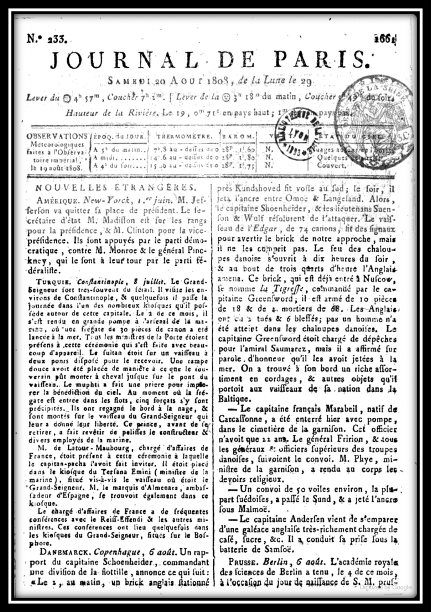
Figure 6: “Nouvelles Étrangeres”, in Journal de Paris, Samedi, 20 Août 1808, de la Lune le 29, No. 233, p. 1661.
Oh, you don’t have your Reading Glasses? Never mind, I shall read it—; what, in English? Then I shall attempt a Translation—for the benefit of the Reader, naturally.
DANEMARCK. Copenhague, 6 août, which is to say, Denmark, Copenhagen, August the 6th. A report from Captain Schoenheider [sic.], Commander of a Division of the Flotilla, announces the following:
On the morning of the 2nd [of this month], an English brick [I mean to say, brig], stationed near Kundshoved moved south; in the evening he [it] threw the anchor between Omoe[1] and Langelande..[2] Then Captain Shoenheider [sic.], and lieutenants Suenson & Wulf, resolved to attack him [he, I should I say, she, being the brig, H.M.S. Tygress]. The 74-gun Edgar’s bucket [sorry, vaisseau, that should be vessel, not bucket] made signals to warn the brig of our approach, but he did not understand them.
The fire of the Danish boats opened at ten o’clock in the evening, and at the end of three-quarters of an hour the Englishman came. This brig, which has already entered Nuscow, is called the Tigress, which is commanded by Captain Greensword; it is armed with 10 pieces of 18 & 2, mortars of 68. The English were 2 killed & 6 wounded; not a man was reached in the Danish chaloupes [boats].
Captain Greensword was in charge of despatches for Admiral Saumarez, but he said on his word of honour that he had thrown them into the sea. There was found on board a rich assortment of ropes and other objects which he carried to the vessels of his nation in the Baltic.” [3]
Herein we learn little of the actual Action between H.M.S. Tygress and the Danish gunboats, only from the point of view of the Victor and nothing of its political Significance.
I am happy to inform you of the latter, but I think you will agree that our prime concern is the fate of your Ancestor and where he, and any other English Seaman, are presently held captive;— Ah! A moment, if you will.
§
Reader, my Monologue was interrupted by a knock at the door. I had asked Mrs. Butler to notify me immediately should a letter from the Navy Office arrive. My hopes were soon dashed, for she had simply brought the cake, standing proud on its plate, still warm and fragrant with the mild aniseed scent of Caraway.
I commended the Housekeeper on her baking, dismissed her, and then set to serving the cake and pouring two generous glasses of Madeira. My Companion and I each put our attention to the delightful Refreshments and, notwithstanding the occasional Observation on the View through the Window onto the Square below, our Conversation flagged.
Reader? You are not surprised, surely? You must have gleaned from the previous Book in this Volume that the Tourist is far from garrulous. Between you and me, sometimes I strain to recall anything that this Individual has actually said! No, it is not because I am hard of hearing. That affectation is a literary Trope I have deliberately adopted in order to enhance the Narrative Presence of the Client in their Family Topography. Tell me if it palls. Actually, please do not.
But what is that? Why, another knock at the door!
§
My Friend, you are not to be disappointed today! I have just received a Transcript of the Letter that Lieutenant Greensword wrote to his Commander-in-Chief 6-days after the Capture of H.M.S. Tygress. It was written 2-days after Captain Schønheyder’s Report, which I just attempted to translate for you.[4] May I have the honour of reading your Relative’s own words to you?
8th August 1808
Sir:
It is my misfortune to have to announce the capture of His Maj. late Gun Brig Tigress under my command by a Division of sixteen Gun Vessels under the Command of Captain Schorneider.
Being ordered by Captain Graves to proceed with the despatches for you, I sailed from Sproe—on the second instant at ½ past 6 pm in falling calm and finding the current to set on to Slaaland, I anchored with the stream, keeping the sails to the masthead ready to take advantage of any breeze that might arise …
Continuing calm I apprehended an attack from the Gun Boats and had therefore prepared for the event, but at sun set we could not perceive them with the glasses from the mast head.
At 10 pm a light air springing up from the S.W. whilst weighing the Anchor some of the Danish Gun Boats were perceived advancing towards us, the night was exceedingly dark though there was a moon, in so much that they were within gun shot before discovered. I immediately ordered the cable to be cut and only being able to count four or five in the first instance, I commenced the action.
I however was soon enabled to perceive that I had to contend such superiority of force that nothing was left me but to effect my escape by any possible means; I therefore put the vessel before the wind in which direction the Edgar laid at about ten to twelve miles distance …
At this time the Starboard fore Yard Arm was shot away and most part of the midday sail geer [gear] both forward and aft; we however got rope up in the tops and succeeded in reeving the geer anew and got the studding sails set—unfortunately the breeze which at one moment appeared to favour us died away.
The gun boats continued to close upon us—I sent the cutter ahead to tow but they still advanced keeping up a brisk fire of grape which cut our rigging to pieces—after contending with and endeavouring to draw them toward the Edgar for about fifty minutes, finding they had formed a compact circular line the centre of which (right astern) within Pistol Shot and pulling up to board.
I advised with Lieutenant Everard (of the Centaur) and Mr. Spence the second master whether it was possible to defend the vessel any longer, they being of the opinion that everything had been done that could possibly be effected to prevent her capture—The Vessel nearly reduced to a wreck both in her hull and rigging, that to wait until we were actually boarded could only [be] a waste of blood without the least ray of hope of ultimate success.
I therefore took the painful resolution of surrendering the Vessel entrusted to my charge: previous to which I ordered Mr. Marks the midshipman who was ahead in the Cutter to effect his escape that the vessel’s fate might be exactly known to Captain Graves; the darkness of night favouring it I trust he succeed in executing this Order.
Lieutenant T.W. Everard unfortunately for him but happily for me was on board. I have not the language to express the high sense I have of his noble and animating conduct: he was in every part of the Deck where he saw he could be of most service, encouraging the Crew by his example and exhortations; he received a splinter wound in the back early in the action but concealed it ‘till it was over.
Mr. Spence the second Master behaved in the most gallant and steady manner. I am much indebted to him as also to Mr. Marks the Midshipman and I hope I may be allowed to speak well of the crew generally; in short the good conduct of the Officers and Crew assisted by the truly animated behaviour of Lieutenant Everard, I have no doubt would have led to a happy result had not the disparity of force been so immense, and I trust we shall be acquitted of blame in surrendering to a flotilla manned with nearly one Thousand Men whilst we were only forty seven at the commencement of the action.
I enclose a list of killed and wounded which I rejoice is so small considering the nature of the contest with every one of the Enemy’s Shot having taken effect either in the Hull Sails or Rigging.
I have &tc. &tc.
Edw. Greensword
To /Sir James Saumarez
Vice Admiral of the Blue, Commander in Chief, &tc. &ct. &tc.
The list of the Dead and Wounded follows thereafter.[5]
§
Reader, once I had read the Letter, the Tourist rose to leave. I have no doubt whatsoever that person was moved beyond speech at hearing of their Relative’s present circumstance. Our farewells were brief.
I promised to send any news of Lieutenant Greensword, and also his young Family—one can only imagine the tears shed by Sarah Ann, and their children, Edward, now aged 9, Francis, 8, Louisa, 5 & Eliza, 3, all of them afraid for the safe-keeping of their dearest Papa these past Weeks. A dreadful business, indeed, except for the possibility Mrs. Greensword does not yet know of her husband’s captivity. When it comes to sea-voyages, many factors can prevent the timely return to one’s home port.
Once my Client departed, I helped myself to another slice of cake and a glass of Madeira to go with it. I then took up the day’s Papers to read. Imagine my dismay when I discovered that the capture of H.M.S. Tygress was reported on this very day in The British Press![6] I could scarcely believe my eyes!
Had I had time to read my morning Papers, I should have saved myself the pain of attempting to translate essentially the same substance published in the Journal de Paris. In fact, I should have had the Benefit of reading a superior, indeed, extended, translation of Captain Schønheyder’s Account published in English.
I shall not reproduce the content herein. Needless to say, you have the faculties & wherewithal to access the information yourself.
This I will reveal is this: the place to which the Danes took H.M.S Tigress was not, according to Captain Schønheyder, “Nuscow”, a place of which I have never heard. I was much relieved when Mrs. Butler arrived with her Cake since I have no doubt it distracted my Guest from any intrusive questions on that count.
Should such a question have formed in your mind, Reader, let me tell you that our British Correspondent solved the Mystery, correctly recording the name of this place as Naskow, Denmark [Nakskov in Danish].[7]

Figure 7. “Copper-plate illustration of the town of Nakskov, Denmark”, Unknown Author, probably 17th century, seen from the south across the strait separating the inner and outer portions of the fjord”.
[1] The Danish name of this island is Omø; it is adjacent to the isle of Agersø. I believe that Tigress was sailing near Langelande Cove and Agersø in the Great Belt, this strait separating the aforementioned islands from Zealand, the island where the Danish Capital is located.
[2] The island of Langeland is located between the Great Belt and Bay of Kiel.
[3] Narrator’s translation of “Nouvelles Étrangeres”, in Journal de Paris, Samedi, 20 Août 1808, de la Lune le 29, No. 233, p. 1661.
[4] I extend my deepest Gratitude to G. S., my Contact in the Navy Office and, coincidentally, a distant relative of Lt. Greensword, for the Transcript of the Letter. Reader, I would gladly inform you of the noble Gentleman’s full name, but necessity compels me to refrain. His ongoing capacity to supply documents concerning the Tourist’s Ancestor relies upon him remaining anonymous.
[5] List of the Return of the killed and wounded on board His Maj. Late Gun Brig the Tygress on Tuesday evening the 2nd day of August 1808:
Henry John Nelson, AB, & Ludwig Britton, Marine, Killed
Samuel Hughes, QM, Wounded Dangerously
James Ames Dublack, Pilot, & Wm. Whittington, Marine, Contused severely
John Johnson & John Mesager, Seamen, Contused severely
Thos. Everard, Lieutenant, Contused badly in the back
Thos. Spence, 2nd Master, Contused Slightly in the back
Chas. Bunting, Assistant Surgeon, Unknown
Edward Nathl. Greensword, Lt. & Commander, Contused Slightly in the Arm
Signed Edwd. N. Greensword, Lt. & Commander
[6] “Capture of the Tigress”, The British Press, Friday, August 26, 1808, No. 1750, p. 3.
[7] Reader, one must move with the times and I shall modernise my spelling accordingly. We must now farewell H.M.S. Tygress and welcome H.M.S. Tigress in her stead, if she is returned to the British. God help us if we ever have to sacrifice the punctuation in acronyms such as H.M.S.!
 A FAMILY TOPOGRAPHY