
The Dog and Duck, a Public House, York-Place, Rotherhithe, Surrey • November 26th, 1796, a Saturday, later that night
You are in need of more Wine, my friend! No? Yes? Why do you hesitate? Come now! Hmm, yes, I agree. One need only witness the Anticks of the Clientele of the Gin-Shops to perceive the Pitfalls of which you speak.
However, you are a Personage of indubitable Respectability and not drinking Gin. Imbibed under the Circumstances in which you find Yourself now afflicted, viz. at Risk of a Chill, Wine is widely regarded as a Therapeutic, if not Curative, Tonic—unless you have Gout. No? Very Good then.
I must say your Colour has improved significantly since our arrival at the Dog and Duck, and you have consumed scarcely half a Pint of Canary Wine. I have every Reason to believe that a little more is likely to be Beneficial, especially if combined with a late Supper for Nourishment. Me? Certainly, for I am rarely in lack of an Appetite.
Now that our Refreshments are arranged, permit me to remind you of our previous Subject, viz. what motivated the Master of the United Society’s School to prepare his Pamphlet for Publication. I must say, I am interested to know how he acquired his Expertise in Navigation. Your Forebear was obviously a Scholar; did he also have Experience as a Mariner? His presence as a young man in Dover, Kent, aroused my Interest in regard to the Latter.
I am able to accurately locate Mr. Joseph Greensword in that great Port, because it was there he married Miss Sarah Grace in the Church of St. Mary The Virgin, Dover, on the 25th of August 1773; the Couple baptised their first-born child in this very Church the following June. If not in search of a Bride, what takes a young man born in London to Dover to find his Fortune?
Well, allow me to tell you that Dover is, “and always hath been, a great nursery for able mariners, and a proper Station for Pilots, to conduct Ships through all the Sands and Flats, either in his Majesty’s Service or the Merchants”.[1] Sadly for our Project, however, such Hyperbole proves no Connexion between your Relative and the Naval or Merchant Maritime Industries in Dover, and neither does the Public Record at this Point in History.
Did the School-Master learn the Nautical Arts at his Father’s knee? What a splendid Question! Joseph Greensword’s father, John, was born in 1712 in Wapping, Middlesex, a Place of Maritime Character almost equivalent to Rotherhithe, albeit on the other Bank of the Thames. I cannot say for certain that Mr. John Greensword was never a Seafarer. However, I am confident that in the year of his son’s Birth, he lived and worked in the Parish of St. Gregory’s by St. Paul.
I know John’s whereabouts in the great Metropolis of London from the Land Taxes he paid on his Tenancy in the West Precinct of St. Gregory’s, which is in the Ward of Castle Baynard (and, sometimes, Candlewick).
Papers seeking Admission to the Freedom of the City for his son, lodged in the year of Joseph’s birth, 1750, state that Mr. John Greensword is a Tin-Plate Worker and a Citizen, viz. a Freeman of the City of London. The Membership of a Livery or Guild being a condition of Freeman status, one may safely conclude that your Ancestor’s Livery was The Worshipful Company of Tin-Plate Workers, alias Wire Workers.
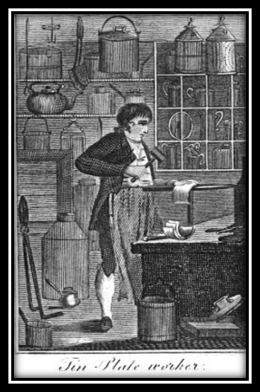
Figure 5. “Tin-Plate Worker”, in Charles Squire, The Book of Trades, Or Library of the Useful Arts, Part III, p. 105.
Of Tin-Plate, the good Mr. Squire informs me that the Manufacture of this Material was still a fairly new Industry in England in the 1740s, most Tin-ware coming from Continental Work-shops and Foundries. Of the Tin-Plate Worker, “it is his business to form [tin sheets] into articles that are represented in the plate [see above], such as kettles, saucepans, canisters of all sorts and sizes, milk-pails, lanthorns, &c. &c.”[2] This apparently humble Calling is, in fact, highly profitable. Mr. Squire refers to the Tin-Plate industry of 1807 in his Book, but his figures shew the Profits of a Master Tin-Smith far exceed the Annual income of a School-Master at the same time!
Mr. Greensword must have been a Master of his Trade because, on the 18th of April, 1755, he took as his Apprentice, Thomas, the son of Mr. Thomas Hampton of St. Margaret Lothbury, London, a Wine Porter. Two Generations henceforth, John’s Grandsons, Edward and Charles, will be Apprenticed to their own father, then of Brook Street, Holborn, Middlesex, and likewise affiliated with the Tin-Plate Workers’ Company through Patrimony.
Yet, as we know, Mr. Joseph Greensword is a School-Master. I should take this Opportunity to reveal that none of his Sons will engage in Occupations with any obvious Relationship to Tin. Indeed, to date, I have been unable to verify John Greensword’s own Admission to the Tin-Plate Workers’ Company. The only Record of a person of his name and age associated with any Guild in the relevant Period of Time was a 14-year-old boy Apprenticed to Mr. Castle Thorpe, of the Company of Vintners, on the 9th day of September in the year 1726.
To return to the Matter at Hand, viz. whether a familial Connexion informs Mr. Joseph Greenword’s navigational Activities, allow me to reveal that his paternal Grandfather was a Mariner. Mr. Lancelot Greensword was born in Stanhope, in the County Palatine of Durham, which is in the General Part of England where the Greensword name and family appear to have originated.
Lest our own Historical Circumstances disrupt our Itinerary and we do not get to Durham in the foreseeable future, let me tell you that Lancelot’s parents were Mr. George Greensword and Mrs. Isabel, the Widow Maddison, nee Westgarth, of Unthank Hall, Stanhope.
That Lancelot was a Mariner is known from the Registry recording his son’s Baptism at St. Dunstan and All Saints, Stepney, in Middlesex, and confirmed by his last Will and Testament, which was prepared in the year of his Marriage, 1707. His wife was Dorothy, the daughter of Mr. Richard and Mrs. Dorothy Paddison (sometimes Padeson, Paddeson, or Paddyson and even Pattison). She married Lancelot on Friday the 4th of July 1707, in Wapping, this event having been recorded in the Clandestine Register of Marriages.[3]
Lancelot’s Will was proved in 1720, his last address being recorded as Stepney. Whether or not he died at Sea, I do not know, but I am quite certain his wife, Mrs. Dorothy Greensword, was in Wapping when she died two years later, leaving John an Orphan at the age of 7.
As an only child, one cannot help but wonder who cared for the boy? His paternal grandparents were presumably in faraway Durham. As to his maternal grandparents, his grandmother, also Dorothy, is proven to have been dead by then and his grandfather, Mr. Richard Paddison, a Throwster and sometime Victualler, was likely so, and if not, then taken up with his third wife, whom he married the previous year, viz. 1720.
Fear not, my stalwart Companion. Our Orphan had numerous Paddison Uncles. As to how many of those half dozen boys survived to Adulthood, that is a Mystery and I regret to tell you that Uncle Ralph, a Mariner, was 34-years-old when he was buried at St. Paul Shadwell in 1725. Perhaps it was Uncle Joseph that took in his orphanned Nephew, since his Christian name was bestowed upon John’s firstborn son?
To bring our Nautical Topic to its Conclusion, the Mariner Grandfather predeceased the birth of our Pamphleteer by almost 3 decades. Methinks it is unlikely Lancelot the Seafarer was lived vividly in the Memory of his son, John, let alone the Imagination of his Grandson, to motivate the latter to write A Very Easy and Short Method, &c. In the absence of any convincing Evidence to the contrary, I must also conclude that our Teacher of Navigation and Lunar Observations was a Theorist, not a Practitioner. This is not to say I believe his Motivation to publish his Pamphlet is purely Academical. In fact, I think it rather likely that there is a Personal element.
As you are aware, An Easy Method &c. &c. was Submitted to, Assessed and, unfortunately, Dismissed by the Board of Longitude in 1794. What you may not know is, during that very same year, our School-Master’s first-born, Edward Nathanael R.N., was in a Ship-Wreck! Could it be that this Event inspired Mr. Joseph Greensword to re-examine and modify his Calculations, which he now prepares to deliver to the Printing Press?
At the time of the Event in Question, the younger Mr. Greensword was an Able Shipman on H.M.S. Rose, to which he was sent on the 23rd of July, 1793. Records show his Ship “assisted at the subjugation of Guadaloupe [sic]” in the West Indies. She was lost on a Reef 2-days out of Port Royal, Jamaica, on the Night of the 28th of June 1794.[4]
My Associates in the Admiralty have told me that, by daylight, her Hull was filled with Water. I am led to believe Officers and Crew were forced to abandon her on Life-Boats and Rafts fashioned out of Spars and Booms, but with no loss of Life.[5] I cannot say whether or not your Ancestor made Shore on a Life-Boat, improvised Raft, Flotsam or Jetsam. In spite of the Demise of H.M.S. Rose, Naval Records shew that young Mr. Greensword remained with that Ship until the 17th of July 1794.
On the 18th of July 1794, Mr. Edward Greensword was sent to H.M.S. Sceptre, a Ship of the Line then stationed in the West Indies. He served aboard until the 19th day of August, 1796, earning a promotion from Midshipman to Master’s-Mate during his tenure. He was sent to the H.M.S. Mozelle on the 20th inst., also as Master’s-Mate, where he served for a mere 3-months. viz. until the 18th of November this year. The School-Master’s Son went to H.M.S. Royal George, Portsmouth, a Week ago!
Fortunately for our Project, Mr. Edward will be back in London this Week and you shall see him in just a few days’ time.
§
Reader, I close this Chapter with a Keepsake for my Client, a Memento that may also assist you to form a Picture in your Mind’s Eye—of the Location of our Accommodations in Rotherhithe.

Figure 6. Mr. H. Smith, “The Dog & Duck at Rotherhithe,” Provenance unknown. Image Courtesy of the Esteemed Dr. And. Byrnes.
[1] Sir John Berlase Warren, A View of the Naval Force of Great-Britain: in which Its Present State, Growth, and Conversion, of Timber; Constructions of Ships, Docks, and Harbours; Regulations of Officers and Men in Each Department; are Considered and Compared with Other European Powers. To which are Added Observations and Hints for the Improvement of the Naval Service, Mr. J. Sewell, Bookseller to the Society for Improvement of Naval Architecture, At the European Magazine Warehouse, no. 32, Cornhill, 1791, p. 53.
[2] Mr. Charles Squire, The Book of Trades, Or Library of the Useful Arts, Part III, Illustrated with twenty Copper-Plates, New Edition, corrected, London, printed for Tabart and Co., no. 157, New Bond-Street, 1807, p. 105.
Some of my Academic Peers have derided my Decision to quote from a Book designed to educate Children. They say I patronise the intended Reader of my Narrative, who, I agree, is likely to be a grown Man or Woman. I would accept this Criticism were it not for the Fact that, as a highly experienced Genealogist, I have become aware of the Rapidity in which diverse Arts, Crafts, Trades, Customs, Traditions, Ideologies, &c. &c., become Redundant and eventually Extinct. I admit that my Approach underestimates Readers of History or Novels, but is perfectly serviceable in respect to the average Modern Reader.
[3] “Lord Hardwicke’s 1774 Act made clandestine marriages like Lancelot and Dorothy’s illegal, requiring all Unions to be solemnised in the Church of England to gain legal Recognitionl.
[4] Lieutenant John Marshall R.N., Royal Naval Biography; or Memoirs of the Service of all the Flag-Officers, Superannuated Rear-Admirals, Retired-Captains, Post-Captains, and Commanders, Whose names appeared on the Admiralty List of Sea Officers at the Commencement of the Present Year, or who have since been Promoted; Illustrated by a Series of Historical and Explanatory Notes, Which will be found to contain an account of all the Naval Actions, and Other Important Events, from the Commencement of the Late Reign, in 1760, to the Present Period. With Copious Addenda. Volume I. Printed for Messrs. Longman, Hurst, Rees, Orme, AND Brown, Paternoster Row. London, Mr. W. Pople, Printer, no. 67, Chancery Lane, 1823, p. 538.
[5] Mr. David J. Hepper, British Warship Losses in the Age of Sail, 1650-1859. Rotherfield, Sussex, published by Ms. Jean Boudriot, 1994, p. 76.
 A FAMILY TOPOGRAPHY