
St. Mary, Rotherhithe, Surrey • 13th of May, 1808, later that morning
Greetings, old Friend! Please accept my most sincere condolences on the death of your Grandfather many-times-removed.
Quite so, quite so. The poor man departed this Life well-short of his allotted three score and ten.[1] But let us look on the bright side: the great virtue of Mr. Joseph Greensword’s Interment here today is that it occurs within the scope of your Convenience and you shall see such members of the family of the Deceased as are able to attend.
I speak, of course, of his beloved Wife, Sarah, and at least two of his sons—these Gentlemen having made themselves known to History—and perhaps their wives and children, too. George Greensword remaining unaccounted for, I refer to his brothers Edward and Charles.
Once might naturally assume the fact of Lieutenant Edward being so often at Sea militates against the possibility of his presence here today. I nevertheless have high hopes he will attend. I have it on good Authority that his Ship, H.M.S. Tygress, was amongst the Squadron led by Admiral Keats in H.M.S. Mars that arrived in Yarmouth “between four and five o’clock” in the morning last Friday, 6th inst., and will remain there “until further orders”.[2] This being the case, it is quite conceivable we shall see Lieutenant Greensword today.[3]
What caused the death of Mr. Greensword the Elder? A natural Question. Unfortunately, Decorum presently prevents me from addressing the necessary inquiries to the Bereaved, so I cannot tell you whether the events leading to his Demise were prolonged or precipitous.
What I can reveal is that the Gentleman and his Wife have endured considerable Worry and Distress in respect to their family the past 18-months or so. It was not Edward, although his little family had their own Sorrows, too. No, it was Charles.
Charles is now aged 24, a married man, and a Shipwright. I believe there is time enough before the Burial Service for me to describe the unfortunate events that have befallen him. Allow me to begin by telling you of his early Accomplishment, which was not insubstantial.
By the time he is 21-years-old, Charles Greensword has his own Firm, conducted in partnership with a Mr. Thomas Kidwell, and registered under the name of Greensword & Kidwell, Shipbuilders, of Itchenor, Sussex, near Chichester. Records show that Mr. Greensword rents their Shipyard from the Duke of Richmond from Michaelmas 1805.[4]
However, I am given to understand that they commenced the build of a 14-gun Brig some weeks earlier, viz. on the 23rd of August 1805. The Brig, H.M.S. Richmond, is launched in February, 1806, this being set down in the Records of the Royal Navy. She is a Confounder-Class Gun-Brig, measuring 84 feet, 6 inches long, 22 feet, 6 inches wide, and weighing 183 tons builder’s measurement. I believe she is presently cruising the North Sea.
My goodness me! I see by the expression on your face that you are surprised a man of 21-years should have responsibility for building one of His Majesty’s ships, not to mention the contingent safety of its future Officers and crew! Let me assure you, my facts are quite straight, being corroborated by both the Parish Record and the Bonds & Allegations that document Charles’ marriage.
Charles Greenword marries Miss Barton here in St. Mary, Rotherhithe on the 15th of May 1806. The Groom’s Parish is given as Itchenor and the Father of the Groom is named as Mr. Joseph Greensword, Gentleman. The bride is just 17-years-old at the time. Eleanor is the daughter of Mr. William Barton, Gentleman, also a Shipwright, of Rotherhithe.
A facsimile of the Marriage Bonds and Allegations, which permit the couple’s Marriage with the Consent of their respective Fathers and the payment of the considerable sum of £200 to the Right Reverend Father Brownlow, Lord Bishop of Winchester, will be included in the published account of your Family Topography. Thus, you shall see Jos. Greensword’s fine signature.

Figure 3: London and Surrey, England, Marriage Bonds and Allegations, 1597-1921, for Charles Greensword and Eleanor Barton
Charles has every Reason to be optimistic about his capacity to care for his Bride and future offspring. After all, construction of H.M.S. Richmond had not even begun when the Ship-builders won the tender for a 5th Rate ship-of-the-line, a Frigate that will one day be H.M.S. Pyramus. This is on the 29th day of June, 1805. Its Keel is laid down in the Yard of Greensword & Kidwell, Itchenor, in April 1806, a month before Charles’s Wedding.
On September the 7th in 1806, Charles becomes the Sole-Trader of Greensword & Kidswell. The Notice of the Dissolution of his Partnership with Mr. Kidwell is reported in The London Gazette on the 18th of October. Mr. Greensword then takes an 89-year lease on a section of land at Mill Wall, Poplar, Middlesex, with the intention of constructing a second Dry Dock. The rent is £250 pounds per annum.
The proposed Dock is anticipated to extend some 196-feet along the river-front, and more than 250-feet inland from the shore-line. Once completed, it will be “capable of receiving up to 74-Gun-Ships, with capital hard-ways &c.”[5] Unfortunately, Mr. Greensword’s optimism is misplaced.
By the 17th of January 1807, Mr. Charles Greensword has been declared bankrupt. His Humiliation is reported in The London Gazette and reiterated in papers across the Country. His Residence is now given as Itchenor and Poplar; his Occupation is described as Shipbuilder, Dealer, and Chapman, the latter being an itinerant Pedlar. [Reader, I would be most interested to know if he hawked chapbooks, but I fear I shall never know.]
Charles is ordered to surrender himself at Guildhall on the 20th & 25th of January and again on the 28th of February.[6]
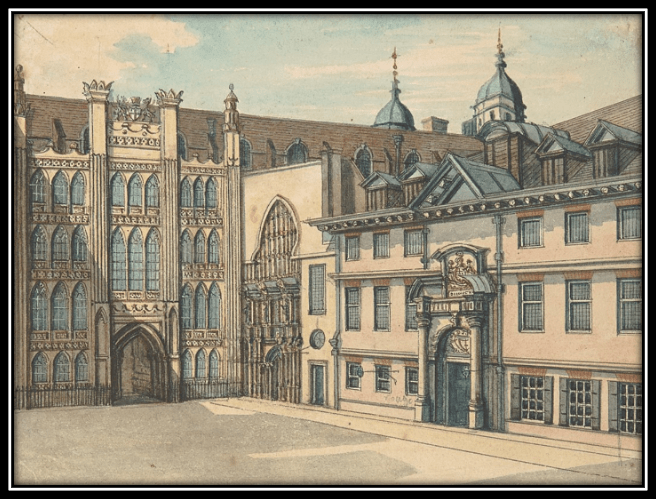
Figure 4: “Guildhall”, Mr. Samuel Ireland, between 1794 and 1800, Watercolor and pen and black ink on paper, 5 in. x 6 ¾ in. Yale Centre for British Art, Paul Mellon Collection.
Mr. Greensword’s Creditors are requested to apply to his Attorneys, Messrs. Mayo and Pearse of Cloak-Lane, London. By then, his wife, Eleanor, is heavy with child. The child, a boy named for his father, is baptised on the 5th of April 1807.
On Friday the 5th of June 1807, the unfinished Dry Dock at Poplar is auctioned at Mr. Garraway’s Coffee-House in Cornhill. An Advertisement for the Sale describes the Dock as “very capital” and “most advantageously situated on the Mill Wall”.[7] A week later, at the premises of the said Dock, the Stock-in-Trade is also auctioned: timber, planks and piles of new and old Oak and Elm as well as seasoned new Beech; and sundry equipment pertaining to Ship-Building.
The same month, the frames for the 36-Gun Frigate and a Brig, which had been under construction at Itchenor, are reported as having been dismantled and sent to the Portsmouth Dry-Dock. According to The Star, the partially completed Vessels were seized upon by the Government, “by virtue of a breach in the original contract”. [8]
Several weeks later, Charles and Eleanor lose their infant son, Charles. The baby is buried on the 14th July 1807 in this Grave-Yard. The Church Register describes his father as a Shipwright and his Residence as Trinity-St. It is possible that Charles and Eleanor reside with Mr. Joseph Greensword and his wife, Sarah, at the time. I cannot be certain, but it is also possible that the Shipwright and his wife reside in Trinity-St. even now.
As for Charles Greensword’s older brother, Edward, and his wife, Sarah Ann, they, too, welcomed a new baby in April 1807. Eleanor Greensword was baptised on the 22nd of April in the Church of St. Leonard, in Deal, Kent.
I regret to tell you that within a month she, too, has died. She is buried in the Grave-Yard of the same Church in Deal on the 18th of May, 1807. One can only hope that the Lieutenant was permitted a Period of Shore-Leave in order to console and care for his Wife and Children.
Two-months later, on the 26th of July 1807, Edward Greensword sets sail from Yarmouth with the Advance Squadron for the Engagement that will become known as the second Battle of Copenhagen. The Squadron is not insignificant, viz.:
The first division of the grand expedition, consisting of the following vessels, sailed from Yarmouth on Sunday evening [with] the following bombs and gun-brigs-—Turbulent, Pincher, Forward, Tygress, Acute, Urgent, Alacrity, Fury, Zebra, and Thunder. This division is not accompanied by troops. The second division under Admiral Essington, which will sail in a few days, will escort nearly 20,000, of whom more than 12,000 are already embarked. The two divisions will join at an appointed rendezvous;[9]
The second Battle of Copenhagen, which commences on the 15th day of August, concludes when the Danes surrender to the British on the 7th of September 1807, whereupon H.M.S. Tygress returns to England.

Figure 5: “Den engelske flåde ud for København august 1807 [The English fleet outside Copenhagen August 1807], 1808, Mr. Christian William Eckersberg. Oil. The Museum of National History, Frederiksborg Hillerod Museum, Denmark.
Lieutenant Greensword sails his Brig from the Downs on another Cruize on the 4th day of October.[10]
By November, Lieutenant Greensword and his Vessel are again stationed on the Copenhagen Roads in the Baltic Sea, one of upwards of 50-Sail of the English Fleet. According to Captain Fraser of His Majesty’s ship, Vanguard, the Tygress forms part of a “chain of communication from Falsterbo to the Middle Ground”, which effectively thwart Danish attempts to intercept new arrivals.[11] In December, H.M.S. Tygress takes as a Prize the merchant Jetzomine den Rifken.[12] On the 27th day of February this year, your Ancestor’s vessel departs Plymouth with a Convoy bound for the Mediterranean. [13]
My esteemed Companion, I have already revealed to you that Lieutenant Greensword and his Ship arrived in Yarmouth last Friday morning and await further orders. We must continue to hope that the Lieutenant has been able to take leave from his Command to travel the 130-miles from Yarmouth to Rotherhithe to farewell his dear Father. Come, let us pay our respects Mr. Joseph Greensword, the late-School-Master of the United Society’s School.
§
Reader, we did not spy Lieutenant Greensword in the Church-Yard that day or remain for long once the last sod of soil was cast into the Grave. I suggested we retire to the Dog and Duck to raise a glass to the School-Master, and this was met with approval.
After a third glass of a Rhenish, however, the Tourist began to cast aspersions on the Lieutenant for his absence from his Father’s burial. I uttered a nervous giggle at the Irony, but quickly realised that Person was oblivious to the significance of their own absence from six Baptisms, one Wedding, and a Funeral during the past dozen years or so!
It was several days before the Newspapers divulged the Lieutenant’s actual whereabouts.
The tardy arrival of the Newspapers to which I subscribe contributed to my misplaced belief that Edward Greensword had opportunity to attend his father’s Funeral, but I have every reason to believe my lack of timely Intelligence was due to a range of other Impediments, viz.: the date of the Event in Question; the date upon which the Report of the Event was submitted to the Newspaper; the date the Paper was published; not to mention the duration of the journey of the Mail-Coach bringing copies of the relevant Newspapers from their various places of Publication to my present whereabouts in Rotherhithe.
The most efficiently delivered was The Ipswich Journal, which was published on Saturday, the 14th of May, the day after Mr. Joseph Greensword’s Burial. I received it on Tuesday. It revealed that on
Tuesday morning [the 10th of May] sailed the Mars of 74 guns, Admiral Keats, Audacious 74, Ranger and Magnet sloops, Zebra bomb, Pincher, Tigress, and Piercer gun brigs, with 100-Sail of Transports, for Norway. The Transports were full of troops under the command of Sir John Moore.[14]
Lieutenant Greensword and his ship had departed Yarmouth three days before the Funeral! In fact, it occurs to me that the Lieutenant may have left the country before his father expired and remains in ignorance of the Death!
Later that day, my copy of Monday’s edition of The Hampshire Chronicle arrived in the afternoon Post. It apprised me of the Fact that as of the previous Monday, viz. the 9th of May, the Fleet remained in the Yarmouth Roads, “but [were] expected to sail, early on Saturday morning, for Norway”.[15] Had I been aware of the Information of the anticipated departure of the Expedition, I might not have encouraged the Tourist to believe there was a good chance of seeing Edward Greensword that day.
[1] Joseph Greensword was 57 when he died. His father was only 43 [See Book I, Chapter 7].
[2] “Yarmouth, Friday May 6”, Morning Post, Monday, 9th May, 1808, No. 11632, p. 3
[3] Diverse Intersections of the various Dimensions of Biography, History, Geography, Genealogy & Topography corroborate Facts, but they also create numerous layers of complexity. My News being based on all due Diligence, I nevertheless cannot guarantee the Lieutenant will appear today.
[4] According the West Sussex History: Journal and Newsletter of the West Sussex Archives Society, the Accounts of the Goodwood Estate show that Mr. Greensword held the lease until 1808.
[5] The Public Ledger and Commercial and General Advertiser, 3 June 1807, Vol. XLVIII, No. 14506, Printed and Published for the Proprietors, by Mr. John Crowder, No. 12, Warwick-Square, near Paternoster-Row, p. 3.
[6] “Bankrupts”, The British Press, Monday 19th of January 1807, No. 1260, p. 4.
[7] Ibid.
[8] The new Keel of the Pyramus was not laid down until November of 1808. “Nautical Intelligence”, The Star, London, Wednesday, 8th June 1808, No. 6045, p. 2.
[9] Stamford Mercury, Thursday, 31st July, 1807, Vol. 76, No. 3984, p. 2
[10] “Ship News”, The Morning Post, Monday 6th October 1806, No. 11119, p. 3.
[11] Kentish Chronicle, Tuesday, 8th December 1807, No. 2908. Printed and published at Canterbury, every Tuesday and Friday, by Mr. William Bristow and Mr. Mawer Cowtan, p. 3.
[12] However, it will not be until the 25th day of November, 1809, that
Notice is hereby given to the Officers and Company of His Majesty’s Gun-Vessel Tigress, Lieutenant Edward Nathaniel Greenfword, Commander, who were actually on board at the Capture of the Jetzomine den Rifken, on the 8th of December 1807, that a Distribution of the Tigress’s Proportion of the Proceeds of the said Prize will be made on Friday the 1st of December next, at No. 13, Great George Street, Westminster; where the same will be recalled for Three Months from that Date. Thomas Maude, Agent. The London Gazette, Tuesday, 28th November 1809, No. 16320, p. 191.
[13] The Morning Post, Tuesday, 1st March, 1808, No. 11554, p. 4.
[14] The Ipswich Journal, Saturday, 14th May, 1808, No. 3905, p. 2.
[15] “London, May 9”, The Hampshire Chronicle, Monday, 16th of May, Vol. 36, No. 1783, p. 4.
 A FAMILY TOPOGRAPHY