
Dunes, Kamperduin, Noord-Holland• 11th October 1797, a Wednesday
The French Revolutionary War continues to convulse Europe. Britain has been at War since February 1793, which is also when France declared War on the Dutch Republic. The Latter fell to the French in 1795, and has become known as the Batavian Republic. This Turn-of-Events has made military Belligerents of erstwhile Rivals for the Spice Trade in the East Indies, and turned the North Sea into Waters of strategic Significance. Permit me to describe the current State-of-Affairs insofar as they pertain to your Forefather.
It is almost three Months since Mr. E. N. Greensword, Masters’-Mate, was sent to H.M.S. Triumph, she being one of the 14 Ships-of-the-Line, [1] 4 Frigates, 6 Sloops & the hired Armed-Cutter, Black Joke, that comprise the North Sea Fleet.[2] Its Admiral is Adam Duncan, Esq. & H.M.S. Venerable carries his Flag.
For the past Month and more, the Royal Navy has held the Dutch Fleet under Blockade in its Harbour at Texel. The enemy Fleet consists of 11 Ships-of-the-Line, 8 Frigates & 7 Sloops, under the Command of Vice-Admiral Jan de Winter on his Flagship, Vrijheid—in English, Vryheid, meaning Freedom).
Early in October, the Admiralty recalled Duncan’s Fleet—including H.M.S. Triumph with Mr. Greensword aboard—to Yarmouth for a Refit and to take on Stores & Victuals. de Winter used the Absence of the British as an Opportunity to lead a Raid in the North Sea, departing on the 8th day of October, a Matter of which his Adversary was swiftly made aware.
According to our old Friend, Mr. Wm. James,
EARLY on the morning of the 9th of October , the Black Joke hired armed-lugger, showed herself at the back of Yarmouth Sands, with the signal flying, for an Enemy. Immediately all was bustle and preparation, and by a little before noon, Admiral Duncan, with eleven Sail-of-the-line, weighed and put to sea; directing his course, with a fair Wind, straight across to his old station off the Texel.[3]
A further three Sail re-joined the Fleet the next day.
Meanwhile, Vice-Admiral de Winter, apprised of the whereabouts of the British by friendly Merchant Ships late on the 10th of October, assembled his Fleet and set sail for Texel.[4]
At 7.00 o’clock this Morning, the 11th day of October 1797, Admiral Duncan received the Signal that the Dutch Fleet were sailing approximately 3-nautical miles southwest.
At ½ past 8 o’clock, the British had the Dutch Fleet in sight, by now about 9-nautical miles from Shore, near the Village of Kamperduin, Anglicised as Camperdown.[5]
At 9 o’clock, Duncan made the Signal to prepare for Battle.
At 12 o’clock, 5 minutes past the Hour to be precise, he signalled his Fleet to engage the Enemy.
At a quarter to 2 o’clock, the Dutch Rear-Guard surrendered to Vice-Admiral Onslow on H.M.S Monarch, which had led the Attack on the Rear-Guard.[6]
My quiet Companion, there before us is the Kamperduin Beach. The Sea is High and the Wind is strong. I predict frequent rainy Squalls, but we have really no Alternative other than to join the Villagers assembled on the Dunes if we are to witness the Action between the Van-Guards.[7]
What is that you say? You cannot hear yourself think over the Din? Never mind! Notwithstanding Sea-Spray and Smoke from Cannons & burning Ships, you shall see the Action, and also read my Narration of the Conflict in your personal Family Topography. In the meantime, may I recommend you dispense with that flimsy Umbrella. Not only is it useless for its intended Purpose in this Gale, it is a positive Menace. Let us now turn our attention to the Waves, and watch the Remainder of the Zeeslag bij Kamperduin unfold.
§
With H.M.S Triumph following second-Astern, Venerable has recently come to the Aid of H.M.S. Ardent. The Latter is warmly engaged with the Vryheid, but has suffered catastrophic Casualties at the hands of the Dutch Flag-Ship. The Ardent’s Commander, Captain Richard Rundle Burges, is dead; all her Officers are injured.
Mr. Lloyd, Professor of Naval History at the Royal Naval College, Greenwich, describes diverse grisly Scenes, including one pertaining to a Woman on Ardent, who “assisted in firing a gun where her husband was quartered, [and] though frequently requested to go below, … would not be prevailed on to do so until a shot carried away one of her legs, and wounded the other”.[8]
“Lucky” Jack Aubrey will later claim to have been a Midshipman on H.M.S. Ardent this day. Personally, I think this is a Fiction, but his Biographer’s account is informative, viz. “when the Vryheid killed or wounded one hundred and forty-nine of his shipmates out of four hundred and twenty-one and reduced the Ardent to something very nearly a wreck: this, and all [Aubrey] had heard of the Dutch, filled him with respect for their seamanship and their fighting qualities”.[9]
Indeed, Venerable and Ardent are now quite surrounded by various Dutch Ships.
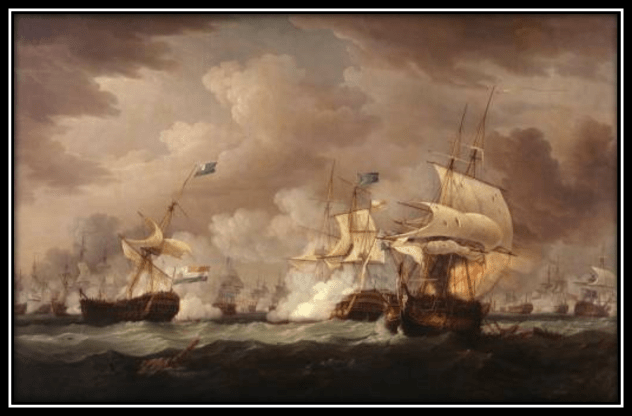
Figure 18. The Battle of Camperdown, 11 October 1797. Mr. Thomas Whitcombe. Oil on canvas, 48 in. x 72 in. c. 1798, National Maritime Museum. H.M.S Venerable is at the centre.
Look! Do look, my Friend. That must be H.M.S. Triumph and she has come to the Aid of her Flag-Ship! Captain Essington brings her close alongside Wassenaar and opens heavy-Fire. Before long, the Dutch Sail surrenders, Captain Holland being dead on his Quarterdeck. However, when H.M.S. Triumph turns back to assist Venerable against Vryheid, Wassenaar raises her Colours once more and follows her back into the Fray.
Fortunately, H.M.S. Bedford, commanded by Captain Sir Thos. Byard, also arrives, attacking Admiraal Tjerk Hiddes De Vries and Hercules.[10] H.M.S. Powerful and H.M.S. Director—both participated in the successful Rear-Guard action under Vice-Admiral Onslow—also join the Battle.
The Wassenaar surrenders again; the Admiraal Tjerk Hiddes De Vries and Gelijkheid also strike their Colours. Now, only Vryheid remains in Battle. Director, under Captain Wm. Bligh, repeatedly rakes her Stern, which is to say, fires Guns into the vulnerable rear of the Dutch Flagship.
By now, considerable Damage has been done to H.M.S Venerable.[11] The plucky Triumph has sustained Injury to her Hull & Masts, but forges on:[12]
THE SERIOUS DAMAGES which the Venerable had sustained, obliged her to haul off, and wear round on the starboard tack. Seeing this, the Triumph, who had compelled the Wassenaar to strike [her Colours], approached to give the coup de grace to the Vryheid. That gallant ship, however, still persisted in defending herself . At length, from the united fire of the Venerable, Triumph, Ardent and Director, her three masts fell over the side and disabled her starboard guns; the Vryheid then dropped out of the line, an ungovernable hulk, and struck her Colours.[13]
It is 3.00 o’clock. The Dutch Vice-Admiral is now “the sole officer unscathed on the deck”.
According to Mr. Padfield, de Winter refused to “haul down his Colours” and it was only when the British boarded the Vyrheid that he conceded Defeat. He was then taken to the Venerable as a Prisoner-of-War.[14] [Reader, given the difficult Conditions my Client and I endured on the Dunes of Kamperduin, I cannot say whose Version of Events is correct.]
It will be told that when he met Adam Duncan, Jan de Winter tendered his Weapon, to which Gesture the noble Duncan responded, “I would much rather take a brave man’s hand than his sword”.[15]
My Companion, I have no doubt whatsoever that there are Artists waiting with Canvas stretched, Paint & Brushes all lined up, Ship-Shape, ready to commemorate today’s Battle. I trust that, courtesy of one such Artist, we may vicariously witness the Tableau aboard H.M.S. Venerable, which we are unable to see from these Dunes. I shall secure the Artist’s consent to reproduce the relevant Painting in the Text of your own Family Topography.
Let us now vacate this frigid Beach. There is nothing more for us to see, but the sorry Aftermath of Battle. Besides, we have quite missed our Dinner. Let us repair to our Inn.
What? Not at all! We will be perfectly safe, for I have the guarantee of our Inn-Keeper, a Dutchman who deplores the Annexation of their Navy in the Service of the French. Ah! You refer to the Food? Fear not. A Bowl of Hutspot, a Loaf of brood, some worst and kaas await us. And remember, the Monopoly the Dutch have over the Spice-Trade shall be to our Advantage this Day. Our Host assures me his Cook keeps Nutmegs & Cinnamon bark in his Larder to grate and spice all manner of Dishes, notably his warm Appelkeok served with rich Cream.
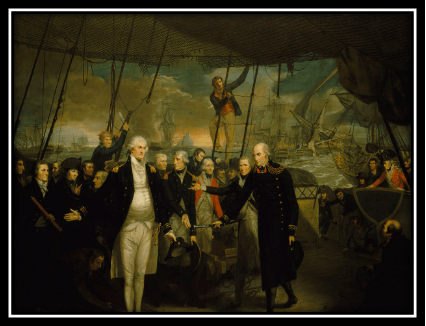
Figure 19. Duncan Receiving the Surrender of De Winter at the Battle of Camperdown, 11 October 1797, Daniel Orme.Oil on canvas, 60in. x 79in. 1797. National Maritime Museum, Greenwich, Caird Collection
§
Reader, with the Permission of my Client, I herein report neither the Conversation in which we engaged, nor the Food we consumed, at our Inn in Kamperduin. Instead, I summarise the Upshot of the Battle and its Consequences for the Naval Career of that Person’s Forefather, Mr. Edward Greensword.
In the Aftermath of the Battle, Duncan ordered his Ships to take control of their Prisoners and Prizes—7 Dutch Ships-of-the-Line and 4 Frigates—and gave Orders to set sail;—some for Yarmouth, several for the Nore, and one to the Downs. Presumably the British Ships also carried the Dead and Injured. A total of 202 British Officers and Seamen lost their lives, 29 of them on Triumph. A Subscription for the Relief of their Widows and Children opens at Lloyd’s Coffee-House.[16] Dutch Fatalities are well more than Twice the British.
Of the British, a further 622 men are injured, 55 on the Triumph, including her first and third Lieutenants.17] Was this the critical moment at which your Ancestor, Mr. Greensword, was made acting-Lieutenant? In the Absence of any other relevant Information, let us assume this to be true until such time as History corrects the Error. Meanwhile his present Ship arrives in Yarmouth on the 17th of October.
The Victory is a Sensation in London! On the 20th of October, Duncan is made Viscount Duncan of Camperdown and Baron Duncan of Lundie (succeeding his late-Brother). The Admiral of the Blue is mobbed by jubilant Crowds when he arrives at a Reception at the Guildhall on the 10th of November 1797.
The King leads a Thanks-Giving Procession and Ceremony in St. Paul’s Cathedral on the 23rd of December, attended by the Royal Family, both Houses of Parliament, and many Persons of High Estate. The London Gazette reports that:
THE PROCESSION was begun from Palace-Yard, at Eight o’Clock in the Morning, by the Chatham Guard of Marines, with their Band, who were followed by Three Waggons, the first bearing the French, the second the Spanish, and the third the Dutch Flags, and attended respectively by the Flag-Officers and Captains in their Carriages, and by Divisions of Seamen, with Lieutenants, Masters’ Mates, and Midshipmen, on Foot: After which marched the Portsmouth Guard of Marines, with their Band. On their Arrival at the South-West Gate of St. Paul’s Church-Yard, the Flags were taken out of the Waggons, and carried into the Cathedral, through the North-West Door, by the Lieutenants attached to them, and attended by the Seamen and Marines, who proceeded to the Place allotted for them under the Dome.[18]
After the First Lesson, the Flag-Officers and Ships’ Captains processed to the Altar to deliver the Flags, Lord Duncan being the Bearer of the Flag of Admiral de Winter. Although I cannot be certain that Mr. Greensword, R. N. participated in the Procession, it seems unlikely he would have missed this Celebration of Britain’s naval Might, to which he contributed.
The Battle of Camperdown and its main Actors are memorialised in a further Works of Art, including ones by Mr. John Singleton Copley and by M. Philippe-Jacques de Loutherbourg, both completed in 1799. In fact, the Art is produced with greater Efficacy than the Prize-Court is able to determine the value of the Prize Money resulting from the Battle. According to a confidential Source, it will take several years, but it will be well worth the wait.
Admiral Duncan and his men will be awarded the incredible Sum of £150,000, shared according to the Calculation I explained in Chapter 9. On the 50th anniversary of the battle, Participants in the Naval Action will be recognised with a Commemorative-Clasp for the Naval General Service Medal.[19] Your Relative’s participation in the Battle of Camperdown brings rather more immediate Rewards.
A Promotion follows within a Year.
Mr. Greensword leaves H.M.S. Triumph on the 13th of May 1798. Less than a Month later, he passes his Lieutenant’s Certificate. The Certification is dated the 6th day of June 1798 at the Naval Office, His Salary more than doubles to £110 per annum. I believe he next goes to the 74-Gun H.M.S. Ramillies, under Captain Bartholomew Rowley, as Lieutenant in October, and is stationed off of Cork.
Not many months after achieving his Seniority, Edward and his wife, Mrs. Sarah Ann, welcome their First-Born. The babe is born on the 6th of September 1798. A month later, on the 7th of October, Edward Duncan Greensword is christened at St. Mary, Rotherhithe, the Parish Church of his paternal Grandparents, Mr. & Mrs. Joseph Greensword. The next day, viz. the 8th inst., Mr. Greensword is sent to H.M.S. Childers, a Brig-Sloop, Channel Fleet, under Commander James O’Bryen (then Commander James Coutts Campbell), where he remains until 1799.
As to the second-name of Mr. & Mrs. Greensword’s infant son, dare I hazard a Guess it is bestowed in Honour of Admiral Adam Duncan, the Hero of the Battle of Camperdown? To my knowledge, the Lieutenant’s son is the first Greensword to be given this Name. It travels down several Generations.
Reader, see below the Royal Navy Lieutenant’s Certificate of Mr. E.N. Greensword, which will enlighten you as to his Nautical Competencies and the Ships upon which he served until 1798.

Figure 20. Edward Nathaniel Greensword, Lieutenant’s Certificate, 1798, The National Archives, Kew, 1817
[1] A “Ship-of-the-Line” is a Warship equipped to engage in a naval Strategy known as the “Line of Battle”. If the Reader wishes to know what constitutes a “Line of Battle”—or distinguishes a Frigate from a Sloop, &c.—may I commend you to an authoritative Glossary of Naval-Terms or a reputable Encyclopædia.
[2] Several Correspondents have already contested my Enumeration of the Dutch and British Fleets. I foresee similar Criticism of my Reportage of the Line-of-Battle in this Chapter. May I say, even as Eye-Witnesses of the Battle of Camperdown, my Companion & I did not have a pan-optical Point of View, making Errors inevitable. I admit that some Errors may have been avoided had we been able to consult with the Villagers on the Dunes, but neither of us speak Dutch.
[3] Mr. William James, The Naval History of Great Britain, Volume 2, 1797–1799. 1827, pp. 98.
[4] Ibid., p. 99.
[6] Mr. Christopher Lloyd, St Vincent & Camperdown, London, Mr. B. T. Batsford, Ltd, 1963, p. p. 143.
[7] Ibid., p. 138.
[8] Ibid., p. 144.
[9] Mr. Patrick O’Brian, Desolation Island, HarperCollins, 1978, p. 145.
[10] Mr. William Laird Clowes, The Royal Navy, A History from the Earliest Times to 1900, Volume IV, Chatham Publishing, 1900, p. 139.
[11] Mr. William James, The Naval History of Great Britain, Volume II, 1797–1799, 1827, p. 70.
[12] In fact, ten of her Guns of have been dismounted.
[14] Mr. Peter Padfield, Nelson’s War, Messrs. Hart-Davis MacGibbon, 1976, p. 103.
[15] Mr. Christopher Lloyd, St. Vincent and Camperdown, London, Mr. B. T. Batsford Ltd., 1963, page unknown.
[16] The London Gazette, Thursday, 16th October, 1798, p. 3.
[17] Mr. William M. James, The Naval History of Great Britain, From the Declaration of War by France, in February 1793, to the Accession of George IV, in January 1820, Volume II, London, printed for Hardling, Lepard and Co., Pall Mall East, 1826, p. 104.
[18] The London Gazette, Issue no. 14075, 23rd of December 1797, p. 1209.
[19] Admiralty Office, The London Gazette, 26th of January 1849, Issue no. 20939, p. 238.
 A FAMILY TOPOGRAPHY