
St. Mary, Rotherhithe, Surrey • 13th of May, 1808, a Friday, morning
Here is the Church of St. Mary, Rotherhithe, and its Grave-Yard. I have come to witness the Burial Rites of the late School-Master of the United Society’s School, Mr. Joseph Greensword. Naturally, I extended an Invitation to my Client, but whether we shall be graced with that Person’ presence, I have no great hope, it being 12-years since we last saw each other. Reader, keep me company in this chilly Church and I shall tell you what has transpired.
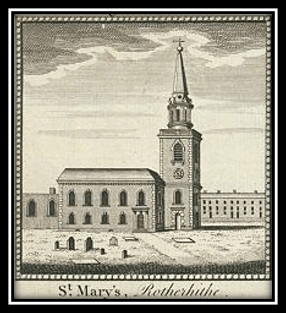
Figure 1: St. Mary, Rotherhithe, in “Various London Churches, plus The Monument”, anonymous engraver, in Thornton’s History of London, c. 1790. Copper engraved print, 7 in. x 12 in., ref G4577.
We last visited this Parish on the Tourist’s maiden genealogical Tour, when we observed the now-Deceased working by candle-light at a writing-table in his abode in Trinity-St., correcting the Manuscript of his Pamphlet on Navigation.[1] Several days later we attended the Nuptials of Mr. & Mrs. Greensword’s eldest son, Edward, and Miss Hopkins in a Church in Holborn. That was in November 1796.
We subsequently undertook a Series of Journeys together, in England and Abroad, following the naval Exploits of the School-Master’s son, and concluding some two-years later with a Ceremony at St. Paul’s Cathedral attended by the Royal Family, both Houses of Parliament, many Persons of High Estate, and, I believe, Mr. Greensword, the Younger. This momentous Occasion was soon followed by the aforementioned Seaman’s Promotion to the Rank of Lieutenant and the birth of his first child, Edward Duncan.
The Baptism of the infant Greensword was held in this very Church on the 7th day of October, 1798.[2] I attended alone, this being on account of the Fact that the Tourist was abruptly indisposed with the Flux. I did not think anything amiss, since it is a common Affliction of the Traveller. However, when young Edward Duncan was baptised for a second time in Antony, Cornwall, the following July, I was amazed the Client did not take advantage of this unique Opportunity to redress their absence from the original Occasion. [3]
I began to suspect an aversion to Cornwall when, in spite of good notice and my undertaking to arrange a Superior Travel Experience, I was again obliged to attend the baptism of an Infant Greensword by myself. Francis Joseph was Christened at the Parish Church of St. Mary & St. Julian in Maker, Cornwall, on the 18th of May, 1800. Maker is a place of small Resort, making my solitary presence there all the more trying.[4]
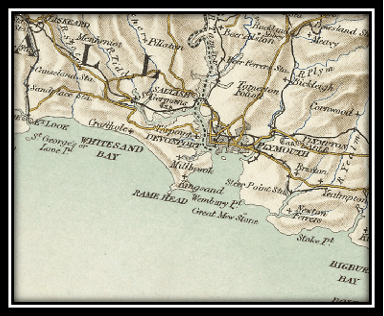
Figure 2: Maker, Cornwall, the village being indicated by the cross marking the Parish Church of St. Mary & St. Julian between Kingsand and Millbrook, across the Sound from Plymouth.
Reader, should you be more curious than the Client, permit me to reveal that Francis Joseph Greensword was born in Kingsand, Devon (now Cornwall). At the time, his father was stationed with the Channel Fleet at Plymouth, having gone to the 74-gun H.M.S. Canada in December 1799. The Lieutenant remained with the Canada for several years, first under Michael de Courcy, then Jos. Syd. Yorke.
In 1803, Lt. Greensword went to the Sea Fencibles in Dover, serving under his old friend and commander, Captain Essington. Mrs. Greensword and their two little boys moved to Kent to be close by. During this period, the couple welcomed two daughters.
The first, Louisa, was born on the 3rd of December 1803 and baptised on Christmas Day at St. Mary the Virgin, Dover, the Church where her paternal Grandparents married and her father, Edward, was christened. Her sister, Eliza, arrived on the 16th of July 1805 and was baptised in the same Church on the 2nd of September 1805 when she was six-weeks-old.
The Tourist did not attend either Christening—; did not even send an Apology. Thus, I came to realise that it was not Cornwall that was the impediment. A reluctance to go to Church, then? Surely not!
Reader, you might well think the Baptism of these several Infants beneath Notice, notwithstanding one of them being the direct Ancestor of my Client. However, even the Submission of a most carefully-curated Itinerary canvassing some of the most significant Events in Mr. Greensword’s naval career during this period failed to engage any Interest whatsoever.
The Tourist not only forfeited the Opportunity of seeing H.M.S Canada engage with the French at Quiberon Bay in June 1800,[5] and a Trip to Jamaica with the 5th West India Regiment in January 1802,[6] but the chance to witness the Demonstration of a new design of Gun-Boat conducted for the benefit of the Prime Minister, Mr. Pitt, on the 12th of September, 1803, which was was attended by Captain Essington, Lieutenants Greensword & Stow, and a great Crowd onshore.[7]
Perhaps the most puzzling of all was the failure to join me at Mr. John Dudman’s, Deptford Dockyard, Surrey, Kent, on the 11th of June, 1804. For it was on this day that H.M.S. Tygress, a 12-gun Archer Class Gun-Brig, was launched on the Thames.[8] Lieutenant Greensword took command of her on the 27th of June, 1804. It took two-months for her to be crewed and provisioned, but she finally set sail on the 26th of August 1804 on her first Cruize, beginning with a Patrol in the Eastern English Channel.
Within the fortnight and enroute to Dunkirk, Tygress captured the De Juffrouw Dengke of Embden. The latter came from Bordeaux loaded with a cargo of Wine, Brandy &c.[9] On the 6th of September, H.M.S. Tygress sailed to Dover. On the 23rd inst., she left the Downs for Dungeness, Kent, in a Convoy commanded by Admiral Lord Keith, returning on the 4th of October 1804.[10] She saw further Action later that month.
On the afternoon of 23rd of October, off the coast of West Flanders in the North Sea, Mr. Greensword’s Brig was sailing in the company of the Sloop, H.M.S. Cruizer, the Gun-Brigs Conflict, Escort & Blazer, and two hired cutters, Admiral Mitchell and Griffin. Together they gave chase to a Flotilla of 2 Praams under French colours & 18 armed Schuyts, which put to sea from Ostend at 4 o’clock, precisely when the British were about to reconnoitre that Port.
According to a Letter written by Captain John Hancock, Commander of Cruizer, the British made pursuit of the Enemy, which they brought into Close Action at ¼ past 5 o’clock. By 5 minutes past 6 o’clock, the Enemy were reduced to “the faint fire of musketry”.[11] The English might have met with Success had darkness not fallen. They soon found themselves in shallow water—the Tide had reduced to a mere 3-fathoms deep and there was no one aboard the Cruizer with any familiarity with the Shoals west of Ostend. As a consequence, the flat-bottomed Praams and Schuyts had the advantage and remained out of reach.
Unfortunately, one zealous commander, Lieutenant Ormsby, pursued the Enemy until his Ship, H.M.S. Conflict, ran aground and was taken by the French. With extreme mortification, Ormsby penned a Letter to the Admiralty describing the Loss of His Majesty’s Brig. As for Commander Greensword, no such humiliation befell his Ship and H.M.S. Tygress returned to the Downs, arriving on the 1st day of November,[12] before departing for yet another Cruize off the French Coast on December the 4th, 1804.[13] The Tourist did not come to farewell their Ancestor on this occasion, either.
Let me be frank, Reader. As exciting as a Family Topographical Tour might sound to you—and in my Opinion, it is exciting, given a Tourist does not merely discover their Ancestors’ exploits, they literally retrace their Footsteps—it is my sorry experience that some lack the Fortitude to walk that Path.
In the present instance, the Client further declined to follow Mr. Greensword’s Cruizes with the Calais Squadron,[14] including the Voyage in April 1806 during which H.M.S. Tygress detained the Prussian Bark, Fortuna.[15] The Prize was put to Auction on the 23rd of October that year, at the York Hotel in Dover;—[16]
Why, I do believe the Person talking to the Curate is the Tourist! Reader, you must excuse me. I need a moment to compose myself!
[1] Which is to say, I speculated that this was the writing with which Joseph Greensword was occupied. It could very well have been a Bill to be paid, an Invoice to be reckoned, a Test to be marked, or some Correspondence or other. My Companion did not challenge me on the implausibility of this particular aspect of my Commentary.
[2] See Volume I, Book I, for the Narrative of this Tour, including the Particulars of the aforementioned Ceremonies.
[3] Reader, I am unable to account for the couple’s decision to re-baptise their infant son. I can only assume that Lt. Greensword was absent when the first was performed seeing as in September & October 1798, he was Acting-Lieutenant on a Cruize to Cork on H.M.S. Childers. In this regard, I am of a mind with the Hon. G.J.F. Simmonds, Naval Historian and Biographer .
[4] Mr. John Marius Wilson’s Imperial Gazetteer of England and Wales (1870-1872), says Maker is “a decayed ancient village and a parish in St. Germans district, Cornwall. The village stands on the W. Side of Plymouth sound”. See GB Historical GIS/University of Portsmouth, History of Maker, in Caradon and Cornwall, Map and description, A Vision of Britain through Time.
[5] Quiberon is a bay on the South Coast of Brittany, more famous for a Battle in 1759 won by the English.[6] Oracle and the Daily Advertiser, Wednesday, 14th September 1803, p. 4.
[6] “Nautical Intelligence”, The Star, London, Monday, 15th March 1802, No. 4158, p. 3.
[7] Oracle and the Daily Advertiser, Wednesday, 14th September 1803, p. 4.
[8] Mr. Bilgerat, “H.M.S. Tigress, Archer Class gun-brigs (1801 and 1804 onwards)”, Kent History Forum, Kent, England, Topic No. 20233.0.
[9] “The Blockading Squadrons”, Caledonian Mercury, Monday, 10th September 1804, No. 12,951, Edinburgh. Printed by Mr. Robert Allan, Fish Market-close, p. 2.
[10] “Naval History of the Present Year, 1804”, in The Naval Chronicle, Containing a General and Biographical History of the Royal Navy of the United Kingdom, with a Variety of Original Papers on Nautical Subjects: Under the Guidance of Several Literary and Professional Men, Vol. XII, July to December, London, Printed and Published by Mr. I. Gold, Shoe-Lane, and Sold by Messrs. Longman, Hurt, Rees & Orme, Mr. Symonds and Mr. Walker, Paternoster-Row; Mr. White, Fleet-Street; Messrs. Vernor & Wood, Poultry; Mr. Asperne, & Messrs. Richardson, Cornhill; Messrs. A. & J. Blacks, and Mr. H. Parry, Leadenhall-Street; Messrs. Crosby and Co., Stationers’ Hall Court; Mr. Ostell, and Mr. A. Law, Avemaria-Lane; Mr. Mottley, Portsmouth; Mr. Haydon, Plymouth; Messrs. Norton & Son, Bristol; Mr. Robinson, Liverpool; Messrs. Manners & Miller, Mr. Creech, and Mr. Constable, Edinburgh; Mr. Archer, Dublin; and the principal Booksellers in the different Seaport towns throughout the United Kingdom, 1804, pp. 328; 331.
[11] Ibid, p. 414.
[12] Kentish Gazette, Friday, 2nd November 1804, No. 3795, Canterbury. Printed and Published by Mr. James Simmons every Tuesday and Friday, p. 4.
[13] The Morning Post, Thursday, 6th December 1804, No. 1125, p. 3.
[14] H.M.S. Tygress participated in several Cruizes as part of the Calais Squadron, one of which was completed on the 9th of August 1805. The Courier, Saturday 10th August 1805, No. 4049, p. 3. Lieutenant Greensword’s Ship returned from a second Cruize on the 25th inst., “Naval Intelligence”, The British Press, Tuesday 27th August 1805, No. 832, p. 4.
[15] The London Gazette, No. 16206, Friday, 13th December 1808, p. 1647.
[16] The Public Ledger and Commercial and General Advertiser, Thursday, 9th October 1806, Vol. XLVI, No. 14265. Printed for the Proprietors, by John Crowder, no. 12, Warwick-square, near Paternoster-Row.
 A FAMILY TOPOGRAPHY